


Page 78 - Technology and Innovation Journal - 19-1
P. 78
416                                   NIJHAWAN


      billion in 2013, and distributions from university  years from just three licenses, the last being Google
      endowment funds, which have accumulated to $466  in 1996. Of 44,902 active industry licenses in the U.S.,
      billion (4) nationally, of which the largest category in   only 222 generated over $1 million annually in 2015.
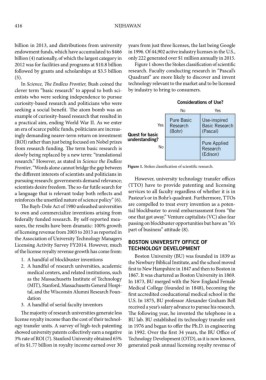
      2012 was for facilities and programs at $10.8 billion     Figure 1 shows the Stokes classification of scientific
      followed by grants and scholarships at $3.5 billion  research. Faculty conducting research in “Pascal’s
      (5).                                        Quadrant” are more likely to discover and invent
        In Science, The Endless Frontier, Bush coined the   technology relevant to the market and to be licensed
      clever term “basic research” to appeal to both sci-  by industry to bring to consumers.
      entists who were seeking independence to pursue
      curiosity-based research and politicians who were             Considerations of Use?
      seeking a social benefit. The atom bomb was an                 No           Yes
      example of curiosity-based research that resulted in
      a practical aim, ending World War II. As we enter      Yes  Pure Basic  Use-inspired
                                                                 Research
                                                                              Basic Research
      an era of scarce public funds, politicians are increas-    (Bohr)       (Pascal)
      ingly demanding nearer-term return on investment   Quest for basic
      (ROI) rather than just being focused on Nobel prizes   understanding?   Pure Applied
      from research funding. The term basic research is      No               Research
      slowly being replaced by a new term: “translational                     (Edison)
      research.” However, as stated in Science the Endless
      Frontier, “Words alone cannot bridge the gap between   Figure 1. Stokes classification of scientific research.
      the different interests of scientists and politicians in
      pursuing research: governments demand relevance;     However, university technology transfer offices
      scientists desire freedom. The so-far futile search for   (TTO) have to provide patenting and licensing
      a language that is relevant today both reflects and   services to all faculty regardless of whether it is in
      reinforces the unsettled nature of science policy” (6).  Pasteur’s or in Bohr’s quadrant. Furthermore, TTOs
        The Bayh-Dole Act of 1980 unleashed universities   are compelled to treat every invention as a poten-
      to own and commercialize inventions arising from   tial blockbuster to avoid embarrassment from “the
      federally funded research. By self-reported mea-  one that got away.” Venture capitalists (VC) also fear
      sures, the results have been dramatic: 100% growth   passing on blockbuster opportunities but have an “it’s
      of licensing revenue from 2003 to 2013 as reported in   part of business” attitude (8).
      the Association of University Technology Managers
      Licensing Activity Survey FY2014. However, much   BOSTON UNIVERSITY OFFICE OF
      of the license royalty revenue growth has come from:   TECHNOLOGY DEVELOPMENT
        1.  A handful of blockbuster inventions     Boston University (BU) was founded in 1839 as
                                                  the Newbury Biblical Institute, and the school moved
        2.  A handful of research universities, academic    first to New Hampshire in 1847 and then to Boston in
         medical centers, and related institutions, such    1867. It was chartered as Boston University in 1869.
         as the Massachusetts Institute of Technology    In 1873, BU merged with the New England Female
           (MIT), Stanford, Massachusetts General Hospi-   Medical College (founded in 1848), becoming the
          tal, and the Wisconsin Alumni Research Foun-   first accredited coeducational medical school in the
         dation                                   U.S. In 1875, BU professor Alexander Graham Bell
        3.  A handful of serial faculty inventors  received a year’s salary advance to pursue his research.
        The majority of research universities generate less  The following year, he invented the telephone in a
      license royalty income than the cost of their technol-  BU lab. BU established its technology transfer unit
      ogy transfer units. A survey of high-tech patenting   in 1976 and began to offer the Ph.D. in engineering
      showed university patents collectively earn a negative   in 1992. Over the first 34 years, the BU Office of
      3% rate of ROI (7). Stanford University obtained 65%   Technology Development (OTD), as it is now known,
      of its $1.77 billion in royalty income earned over 30   generated peak annual licensing royalty revenue of

