


Page 214 - MARSIUM'21 COMP OF PAPER
P. 214
The survey questions were adapted from Schivinski and Dabrowski's (2015) using a five-point Likert scale. Links
               to surveys were distributed by direct messages to WhatsApp and Facebook users to encourage them to participate in the
               research. The invitation to the questionnaire included information about the objectives of the study. A brief example was given
               to assist respondents in differentiating between two distinct sorts of social media brand communications. In Part C of the
               questionnaire, a 5-point Likert Scale was used, ranging from 1 (Strongly Disagree) to 2 (Disagree), 3 (Neutral), 4 (Agree), and
               finally 5 (Strongly Agree). Data was reviewed, processed, and analyzed following data collection using the Statistical Package
               for the Social Sciences (SPSS).


               ⬛    4.0 FINDING AND ANALYSIS
                       This section analyses and summarizes the survey findings on social media brand communication to increase brand
               equity (brand awareness and perceived quality) of electrical component retailers. This study primarily employed three types
               of analysis: normality, reliability, and multiple regression.


             4.1 RESPONSE RATE

                       The survey was distributed to respondents through social media such as WhatsApp, Facebook, Instagram, and
               LinkedIn. The population of study was composed of Facebook users in Malaysia who had liked or followed any electronic
               components retailers page or product before. Out of 217 responses, 67 responses were rejected due to respondents did not
               fulfill the qualifying requirement for the study. Hence, 150 was usable for data analysis and recorded a response rate of 69.12
               %.

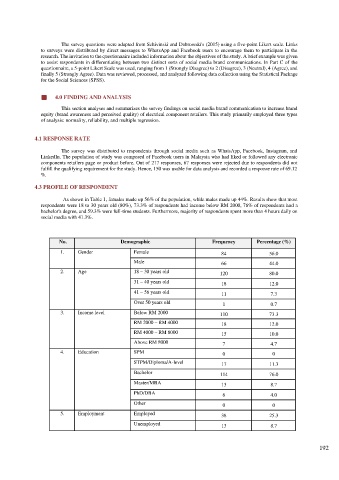
             4.3 PROFILE OF RESPONDENT

                       As shown in Table 1, females made up 56% of the population, while males made up 44%. Results show that most
               respondents were 18 to 30 years old (80%), 73.3% of respondents had income below RM 2000, 76% of respondents had a
               bachelor's degree, and 59.3% were full-time students. Furthermore, majority of respondents spent more than 4 hours daily on
               social media with 41.3%.


                      No.                  Demographic                      Frequency      Percentage (%)

                      1.    Gender              Female                         84               56.0
                                                Male                           66               44.0
                      2.    Age                 18 – 30 years old             120               80.0
                                                31 – 40 years old              18               12.0
                                                41 – 56 years old              11               7.3

                                                Over 50 years old              1                0.7
                      3.    Income level        Below RM 2000                 110               73.3
                                                RM 2000 – RM 4000              18               12.0
                                                RM 4000 – RM 8000              15               10.0
                                                Above RM 8000                  7                4.7
                      4.    Education           SPM                            0                 0

                                                STPM/Diploma/A-level           17               11.3
                                                Bachelor                      114               76.0
                                                Master/MBA                     13               8.7

                                                PhD/DBA                        6                4.0
                                                Other                          0                 0
                      5.    Employment          Employed                       38               25.3
                                                Unemployed                     13               8.7


                                                                                                                 192

