


Page 215 - MARSIUM'21 COMP OF PAPER
P. 215
Self-employed                  9                6.0
                                                Retired                        1                0.7

                                                Full-time student
                                                                               89               59.3
                      6.    Daily social media   Less than 1 hour              9                6.0
                            usage
                                                1 – 2 hours                    26               17.4

                                                2 – 4 hours                    53               35.3
                                                More than 4 hours              62               41.3
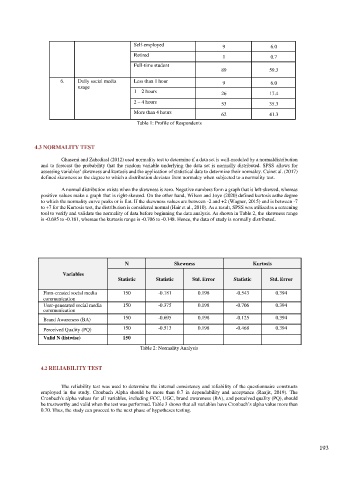
                                                 Table 1: Profile of Respondents


             4.3 NORMALITY TEST

                       Ghasemi and Zahediasl (2012) used normality test to determine if a data set is well-modeled by a normal distribution
               and to forecast the probability that the random variable underlying the data set is normally distributed. SPSS  allows for
               assessing variables’ skewness and kurtosis and the application of statistical data to determine their normalcy. Cain et al. (2017)
               defined skewness as the degree to which a distribution deviates from normalcy when subjected to a normality test.

                       A normal distribution exists when the skewness is zero. Negative numbers form a graph that is left-skewed, whereas
               positive values make a graph that is right-skewed. On the other hand, Wilson and Joye (2020) defined kurtosis as the degree
               to which the normality curve peaks or is flat. If the skewness values are between -2 and +2 (Wagner, 2015) and is between -7
               to +7 for the Kurtosis test, the distribution is considered normal (Hair et al., 2010). As a result, SPSS was utilized as a screening
               tool to verify and validate the normality of data before beginning the data analysis. As shown in Table 2, the skewness range
               is -0.695 to -0.181, whereas the kurtosis range is -0.706 to -0.148. Hence, the data of study is normally distributed.


                                             N                Skewness                    Kurtosis

                       Variables
                                           Statistic    Statistic    Std. Error    Statistic    Std. Error

                Firm-created social media   150          -0.181        0.198        -0.543        0.394
                communication
                User-generated social media   150        -0.375        0.198        -0.706        0.394
                communication
                Brand Awareness (BA)        150          -0.695        0.198        -0.125        0.394

                Perceived Quality (PQ)      150          -0.513        0.198        -0.468        0.394
                Valid N (listwise)          150

                                                  Table 2: Normality Analysis


               4.2 RELIABILITY TEST


                       The reliability test was used to determine the internal consistency and reliability of the questionnaire constructs
               employed  in  the  study.  Cronbach  Alpha  should  be  more  than  0.7  in  dependability  and  acceptance  (Ranjit,  2019).  The
               Cronbach's alpha values for all variables, including FCC, UGC, brand awareness (BA), and perceived quality (PQ), should
               be trustworthy and valid when the test was performed. Table 3 shows that all variables have Cronbach’s alpha value more than
               0.70. Thus, the study can proceed to the next phase of hypotheses testing.


                                                                                                                 193

