


Page 256 - MARSIUM'21 COMP OF PAPER
P. 256
2.6.4 Interaction and Perceived Value
               Effective interaction on social media enhances consumers’ satisfaction and eliminates consumers’ unpleasant feelings towards
               a brand (Zamani et al., 2019). The study of Xie et al. (2021) found that there are three types of interaction that could lead to
               stronger customer’s perceived value which are customer-environment interaction, customer-service employee interaction and
               customer-customer  interaction. Customer–employee  interactions  can  induce  customers’  perception of  the  service  staff  as
               honest and kind while customer-customer interaction promotes perceptions of value creation among the consumers. During
               the process of social interaction, the consumer's perceived value towards the brand will increase if there is more recognition
               gained from others about the brand (Gan and Wang, 2017). In addition, Juliana et al. (2021) proved that the perceived value
               of online channels can be brought by frequent interaction among businesses and consumers. Hence, frequent interaction on
               social media will lead to the increase of consumers’ perceived value (Jakic et al., 2017). Thus, this study proposes a hypothesis
               as follows:
               Hypothesis 4: Interaction has a significant and positive effect on perceived value.


               2.6.5 Trust and Purchase Intention
               Trust is one of the important criteria that directly influences the customer purchase intention (Kaur and Khanam, 2015; Liu
               and Tang, 2018). Trust is significant to reinforce the relationship between customers and organizations (Moslehpour et al.,
               2021). Businesses that deliver accurate and suitable information about their product or services on the site can build trust
               among the consumers and hence increase their purchase intention (Chen et al., 2018). As found in the study of Teng and Wang
               (2015), consumer trust brings a beneficial impact on consumers’ purchase intention. Trust also enables the building of a
               continuing, long-term relationship (Zhu et al., 2020). According to Nadeem et al. (2015), trust is a crucial criterion in any
               transaction especially when it involves social media. This is because many people are giving their opinions about a product or
               service on social media platforms. As highlighted by Zheng et al. (2017), trust can encourage future purchase intention and
               enable the development of successful long-term relationships. This study thus hypothesizes the following:
               Hypothesis 5: Trust has a significant and positive effect on purchase intention.


               2.6.6 Perceived Value and Purchase Intention
               Perceived value is associated with the purchase intention (Persaud and Schillo, 2017). The perceived value indicates consumers’
               perceived preference towards a product that could increase their purchase intention (Wu and Chang, 2016). Perceived value
               can be further categorized into hedonic value and utilitarian value. According to Gan and Wang (2017), consumers with higher
               levels of perceived values have a higher probability to have a higher level of satisfaction towards the product or service and
               hence  the purchase  intention  will  be higher.  The  positive  value bought by  the  social  media  website  will  positively  and
               significantly affect consumers’ purchase intention (Chen et al., 2018). Besides, Nyffenegger et al. (2015) found that perceived
               value is an important factor that drives consumers’ purchase intention. Similarly, Chen et al. (2018) stated that with a higher
               perceived value, there will be a lower perceived risk towards the product or service and hence the likelihood that customers
               purchase it will be higher. Thus, the following hypothesis is proposed:
               Hypothesis 6: Perceived value has a significant and positive effect on purchase intention.


               2.7 RESEARCH FRAMEWORK


                      ENTERTAINMENT
                                               H1

                                         H2               TRUST              H5
                                                                                       PURCHASE
                                                                                       INTENTION
                                          H3
                                                        PERCEIVED            H6
                                                          VALUE
                                               H4
                        INTERACTION

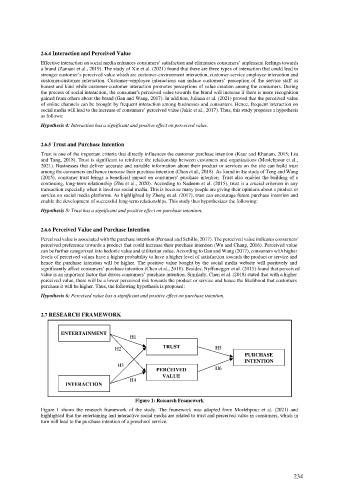
                                                 Figure 1: Research Framework
               Figure  1  shows  the  research  framework  of  the  study.  The  framework  was  adopted  from  Moslehpour  et  al.  (2021)  and
               highlighted that the entertaining and interactive social media are related to trust and perceived value in consumers, which in
               turn will lead to the purchase intention of a preschool service.


                                                                                                        234

