


Page 261 - MARSIUM'21 COMP OF PAPER
P. 261
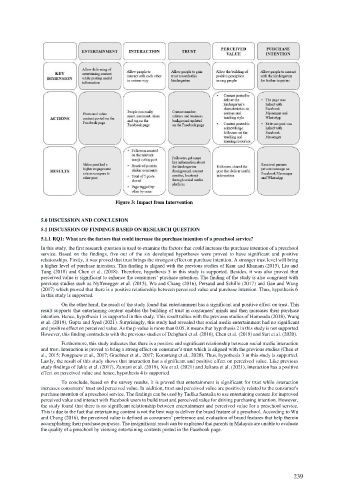
Figure 3: Impact from Intervention


               5.0 DISCUSSION AND CONCLUSION
               5.1 DISCUSSION OF FINDINGS BASED ON RESEARCH QUESTION
               5.1.1 RQ1: What are the factors that could increase the purchase intention of a preschool service?
               In this study, the first research question is used to examine the factors that could increase the purchase intention of a preschool
               service.  Based  on  the  findings,  five  out  of  the  six  developed  hypotheses  were  proved  to  have  significant  and  positive
               relationships. Firstly, it was proved that trust brings the strongest effect on purchase intention. A stronger trust level will bring
               a higher level of purchase intention. This finding is aligned with the previous studies of Kaur and Khanam (2015), Liu and
               Tang (2018) and Chen et al. (2018). Therefore, hypothesis 5 in this study is supported.  Besides, it was also proved that
               perceived value is significant to enhance the consumers’ purchase intention. The finding of the study is also congruent with
               previous studies such as Nyffenegger et al. (2015), Wu and Chang (2016), Persaud and Schillo (2017) and Gan and Wang
               (2017) which proved that there is a positive relationship between perceived value and purchase intention. Thus, hypothesis 6
               in this study is supported.
                       On the other hand, the result of the study found that entertainment has a significant and positive effect on trust. This
               result supports that entertaining content enables the building of trust in consumers' minds and then increases their purchase
               intention. Hence, hypothesis 1 is supported in this study. This result tallies with the previous studies of Hamouda (2018), Wang
               et al. (2019), Gupta and Syed (2021). Surprisingly, this study had revealed that social media entertainment had no significant
               and positive effect on perceived value. As the p-value is more than 0.05, it means that hypothesis 2 in this study is not supported.
               However, this finding contradicts with the previous studies of Dehghani et al. (2016), Chen et al. (2018) and Sari et al. (2020).
                       Furthermore, this study indicates that there is a positive and significant relationship between social media interaction
               and trust. Interaction is proved to bring a strong effect on consumer’s trust which is aligned with the previous studies (Chen et
               al., 2015; Pongpaew et al., 2017; Graebner et al., 2017; Koranteng et al., 2020). Thus, hypothesis 3 in this study is supported.
               Lastly, the result of this study shows that interaction has a significant and positive effect on perceived value. Like previous
               study findings of Jakic et al. (2017), Zamani et al. (2019), Xie et al. (2021) and Juliana et al. (2021), interaction has a positive
               effect on perceived value and hence, hypothesis 4 is supported.
                       To conclude, based on the survey results, it is proved that entertainment is significant for trust while interaction
               increases consumers’ trust and perceived value. In addition, trust and perceived value are positively related to the consumer's
               purchase intention of a preschool service. The findings can be used by Tadika Santalia to use entertaining content for improved
               perceived value and interact with Facebook users to build trust and perceived value for driving purchasing intention. However,
               the study found that there is no significant relationship between entertainment and perceived value for a preschool service.
               This is due to the fact that entertaining content is not the best way to deliver the brand feature of a preschool. According to Wu
               and Chang (2016), the perceived value is defined as consumers’ preference and evaluation of brand features that help them in
               accomplishing their purchase purposes. The insignificant result can be explained that parents in Malaysia are unable to evaluate
               the quality of a preschool by viewing entertaining contents posted in the Facebook page.


                                                                                                        239

