


Page 360 - MARSIUM'21 COMP OF PAPER
P. 360
339                                        Ali & Ahmad (2018)

               higher interactivity on user satisfaction, value, and overall attitude in an e-commerce purchasing program by experimentally adjusting
               interactivity  using  numerous  elements  such  as  chat  and  feedback  forms.  As  Sutcliffe  (2005)  found,  interactive  metaphors  have  a
               favourable impact on consumers' perceptions of website design. Higher  levels of involvement were also found to have an effect  on both
               the website and the product or service in question, according to a separate study (Xu & Sundar, 2014). Based on the explanation above,
               the researchers hypothesize:

               H4: KKKL Express’s website interactivity will have a strong influence on user satisfaction.


            2.5 RESEARCH FRAMEWORK MODEL


                        Information Content (H1)


                         Visual Aesthetics (H2)
                                                                       User Satisfaction

                           Navigation (H3)


                           Interactivity (H4)


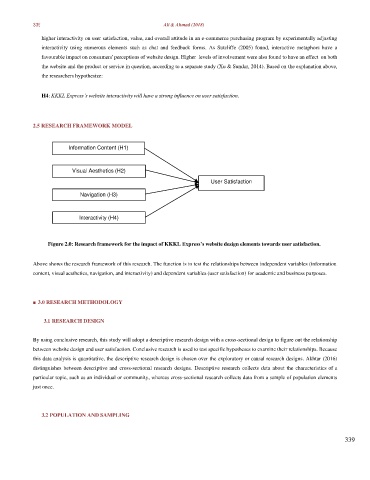
                 Figure 2.0: Research framework for the impact of KKKL Express’s website design elements towards user satisfaction.


            Above shows the research framework of this research. The function is to test the relationships between independent variables (information
            content, visual aesthetics, navigation, and interactivity) and dependent variables (user satisfaction) for academic and business purposes.


            ■ 3.0 RESEARCH METHODOLOGY


                3.1 RESEARCH DESIGN


            By using conclusive research, this study will adopt a descriptive research design with a cross-sectional design to figure out the relationship
            between website design and user satisfaction. Conclusive research is used to test specific hypotheses to examine their relationships. Because
            this data analysis is quantitative, the descriptive research design is chosen over the exploratory or causal research designs. Akhtar (2016)
            distinguishes between descriptive and cross-sectional research  designs.  Descriptive research  collects  data  about the  characteristics of a
            particular topic, such as an individual or community, whereas cross-sectional research collects data from a sample of population elements
            just once.


               3.2 POPULATION AND SAMPLING


                                                                                                                   339

