


Page 361 - MARSIUM'21 COMP OF PAPER
P. 361
340                                        Ali & Ahmad (2018)

            When designing a study, it is critical to select a population and sample size that are acceptable for the study's goals.  Sample is a portion of
            a population or universe (Tailor, 2005). Also, the sampling process defines how a sample is determined for the selected population. Then, a
            population is made up of a distinct group of humans, whether that group is comprised of a nation or people who share a common characteristic
            (Momoh, 2021). Thus, the entire group from which the sample was obtained is referred to as the "population," while the group chosen for
            research is referred to as the "sample." The population of this survey is focused on respondents of students in University Technology Malaysia
            (UTM) Skudai, Johor Bahru and the one who have experienced browsing  KKKL Express’s website will be regarded as representative
            samples. The researcher will then use the Tabachnick method to calculate the sample size. According to Tabachnick and Fidell (2007), a
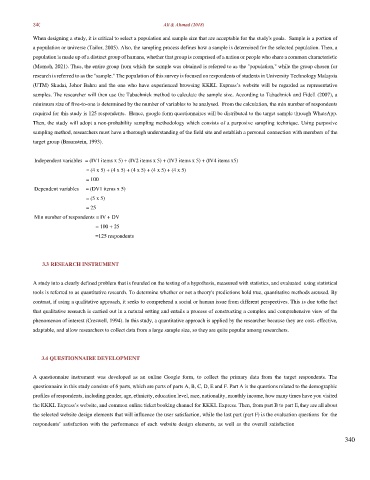
            minimum size of five-to-one is determined by the number of variables to be analysed.  From the calculation, the min number of respondents
            required for this study is 125 respondents.  Hence, google form questionnaires will be distributed to the target sample through WhatsApp.
            Then, the study will adopt a non-probability sampling methodology which consists of a purposive sampling technique. Using purposive
            sampling method, researchers must have a thorough understanding of the field site and establish a personal connection with members of the
            target group (Braunstein, 1993).

            Independent variables  = (IV1 items x 5) + (IV2 items x 5) + (IV3 items x 5) + (IV4 items x5)
                              = (4 x 5) + (4 x 5) + (4 x 5) + (4 x 5) + (4 x 5)
                              = 100
            Dependent variables   = (DV1 items x 5)
                              = (5 x 5)
                              = 25
            Min number of respondents = IV + DV
                                 = 100 + 25
                                 =125 respondents


               3.3 RESEARCH INSTRUMENT


            A study into a clearly defined problem that is founded on the testing of a hypothesis, measured with statistics, and evaluated  using statistical
            tools is referred to as quantitative research. To determine whether or not a theory's predictions hold true, quantitative methods are used. By
            contrast, if using a qualitative approach, it seeks to comprehend a social or human issue from different perspectives. This is due to the fact
            that qualitative research is carried out in a natural setting and entails a process of constructing a complex and comprehensive view of the
            phenomenon of interest (Creswell, 1994). In this study, a quantitative approach is applied by the researcher because they are cost- effective,
            adaptable, and allow researchers to collect data from a large sample size, so they are quite popular among researchers.


               3.4 QUESTIONNAIRE DEVELOPMENT


            A  questionnaire  instrument  was  developed  as  an  online  Google  form,  to  collect  the  primary  data  from  the  target  respondents.  The
            questionnaire in this study consists of 6 parts, which are parts of parts A, B, C, D, E and F. Part A is the questions related to the demographic
            profiles of respondents, including gender, age, ethnicity, education level, race, nationality, monthly income, how many times have you visited
            the KKKL Express’s website, and common online ticket booking channel for KKKL Express. Then, from part B to part E, they are all about
            the selected website design elements that will influence the user satisfaction, while the last part (part F) is the evaluation questions  for  the
            respondents’  satisfaction  with  the  performance  of  each  website  design  elements,  as  well  as  the  overall  satisfaction

                                                                                                                   340

