


Page 395 - MARSIUM'21 COMP OF PAPER
P. 395
374                                        Lim Huey Nee & Mazilah (2022)

                   Descriptive Analysis            Numerical  form  in  descriptive  analysis
                                                   can be analysed and transformed from the
                                                   frequency, mean and mode
                                                   percentage, and standard deviation.
                   Normality Analysis              To  determine  whether  a  dataset  is  well  Skewness and  kurtosis =  +2 to -2
                                                   modelled  by  a  normal  distribution  and  (Garson, 2012)
                                                   calculate the likelihood that random
                                                   variables  under  the  dataset  follow  a
                                                   normal distribution.
                   Reliability Analysis            To ensure the variables and scales used  More than 0.7 (Hair, 2010)
                                                   in the questionnaire are trustworthy and
                                                   reliable.
                   Univariate Analysis             To prevent outliers by measuring the   Mahala Nobis D Square Test
                                                   range and variation of the dispersion in  Z score between +4 to -4 (Hair,2010)
                                                   the data collected.
                   Multivariate Analysis           To investigate more complex datasets   Mahala Nobis D Square Test
                                                   than  univariate  analysis  methods  can   Z score between +4 to -4 (Hair,2010)
                                                   handle.
                   Multicollinearity Analysis      A statistical concept in which several   Tolerance more than 0.2; VIF below
                                                   independent variables in a model are   than 10 (Garson, 2012; Pallant, 2015)
                                                   related.
                   Multiple Regression Analysis    A  statistical  tool  for  studying  the  p<0.1, **p<0.05, **p<0.001
                                                   relationship  between  two  or  more
                                                   variables.


            ■ 4.0 DATA ANALYSIS PLAN

            This  study  collected  126  responses  to  analysis.  The  researcher  discussed  preliminary  testing,  demographic  statistics,  normality  test,
            multicollinearity analysis, and multiple analyses in this research.


            4.1 RELIABILITY TEST

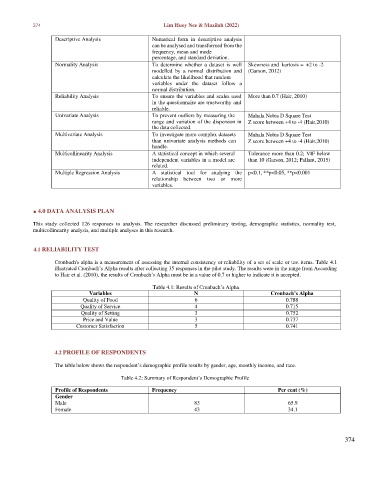
                   Cronbach's alpha is a measurement of assessing the internal consistency or reliability of a set of scale or test items. Table 4.1
                   illustrated Cronbach’s Alpha results after collecting 35 responses in the pilot study. The results were in the range from According
                   to Hair et al. (2010), the results of Cronbach’s Alpha must be in a value of 0.7 or higher to indicate it is accepted.

                                                    Table 4.1: Results of Cronbach’s Alpha
                               Variables                         N                         Cronbach’s Alpha
                             Quality of Food                     6                              0.788
                            Quality of Service                   4                              0.715
                            Quality of Setting                   3                              0.752
                             Price and Value                     3                              0.737
                          Customer Satisfaction                  5                              0.741


                   4.2 PROFILE OF RESPONDENTS

                   The table below shows the respondent’s demographic profile results by gender, age, monthly income, and race.

                                         Table 4.2: Summary of Respondent’s Demographic Profile

                   Profile of Respondents          Frequency                                 Per cent (%)
                   Gender
                   Male                                          83                             65.9
                   Female                                        43                             34.1


                                                                                                                   374

