


Page 409 - MARSIUM'21 COMP OF PAPER
P. 409
contrast, causal research is a method for evaluating the relationship between two variables: cause and effect (Bhasin, 2020). The main purpose
            is to prove the existence of a relationship between cause and effect. The relationship between independent variables and the influence they
            have on dependent variables can be explored by researchers by using causal research (Marvasti, 2018). Therefore, this study adopted the
            conclusive research design comprised of descriptive research and cross-sectional design to investigate the relationships between social media
            marketing  efforts,  consumers’  engagement  with  brand-related  social  media  content,  brand  equity,  and  purchase  intention  of
            telecommunication services.


            3.2 POPULATION AND SAMPLING

             Population is defined as a specific group of people, regardless of the same nation or a group of people who share a trait (Momoh, 2021).
           While target population is referred to a specific group of people whose outcomes will be compared. Thus, the target population of this study
           is individuals who liked and followed any of a telecommunication brand on social media platforms. Meanwhile, according to Vijayamohanan
           (2021),  the  sampling  process  is  entities  (e.g., persons,  households,  and  organizations)  selected  from  a  population  (universe)  of  interest.
           Therefore, reasonably generalize findings back to the population were chosen by analyzing the sample. The sample is the group of people who
           have been chosen to be the respondents in research. Most statisticians agree that a minimum sample size of 100 is required to obtain a significant
           result of any kind (Piroska, 2021). The researcher should survey more respondents if there are not more than 100 people in the population.
           Furthermore, reasonable maximum sample size cannot be more than 1000, typically approximately 10% of the population. According to Azraii
           et al. (2021), the sample size is calculated based on the subject-to-item ratio of 5:1. Therefore, the minimum sample size of this study is 205
           (41 items × 5 = 205). The target of respondents for this study is social media users who had their internet data plan and had liked and followed
           any telecommunication brand on social media. Therefore, the method of non-probability sampling known as purposive sampling technique
           was used in this study.

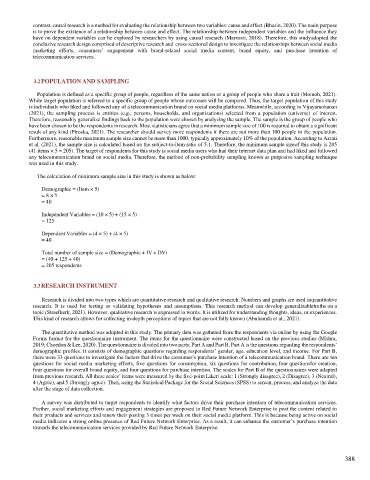
             The calculation of minimum sample size in this study is shown as below:

               Demographic = (Item × 5)
               = 8 × 5
               = 40

               Independent Variables = (10 × 5) + (15 × 5)
               = 125

               Dependent Variables = (4 × 5) + (4 × 5)
               = 40

               Total number of sample size = (Demographic + IV + DV)
               = (40 + 125 + 40)
               = 205 respondents


            3.3 RESEARCH INSTRUMENT

               Research is divided into two types which are quantitative research and qualitative research. Numbers and graphs are used in quantitative
            research.  It  is  used  for  testing  or  validating  hypotheses  and  assumptions.  This research method can develop generalizable truths on a
            topic (Streefkerk, 2021). However, qualitative research is expressed in words. It is utilized for understanding thoughts, ideas, or experiences.
            This kind of research allows for collecting in-depth perceptions of topics that are not fully known (Abuhamda et al., 2021).

               The quantitative method was adopted in this study. The primary data was gathered from the respondents via online by using the Google
            Forms format for the questionnaire instrument. The items for the questionnaire were constructed based on the previous studies (Mishra,
            2019; Choedon & Lee, 2020). The questionnaire is divided into two parts: Part A and Part B. Part A is the questions regarding the respondents’
            demographic profiles. It consists of demographic questions regarding respondents’ gender, age, education level, and income. For Part B,
            there were 33 questions to investigate the factors that drive the consumer’s purchase intention of a telecommunication brand. There are ten
            questions  for  social media marketing efforts, five questions  for consumption,  six questions for  contribution, four questions for creation,
            four questions for overall brand equity, and four questions for purchase intention. The scales for Part B of the questionnaires were adapted
            from previous research. All these scales’ items were measured by the five-point Likert scale: 1 (Strongly disagree), 2 (Disagree), 3 (Neutral),
            4 (Agree), and 5 (Strongly agree). Then, using the Statistical Package for the Social Sciences (SPSS) to screen, process, and analyze the data
            after the stage of data collection.

               A survey was distributed to target respondents to identify what factors drive their purchase intention of telecommunication services.
            Further, social marketing efforts and engagement strategies are proposed to Red Future Network Enterprise to post the content related to
            their products and services and renew their posting 3 times per week on their social media platform. This is because being active on social
            media indicates a strong online presence of Red Future Network Enterprise. As a result, it can enhance the customer’s purchase intention
            towards the telecommunication services provided by Red Future Network Enterprise.


                                                                                                                   388

