


Page 567 - MARSIUM'21 COMP OF PAPER
P. 567
which in turn boost the brand loyalty and brand passion. According to Fischer and Reuber (2011), consumers feel the social
               satisfaction or brand passion when they go through the user-generated content, and it notably impacts their behavioral responses.
               Consumers feel the pleasure with user-generated content on social media platform because they can participate and get involved in
               sharing their passion for a brand with other consumers who share the similar interest (Habibi et al., 2014) and produce the sense of
               community among them. In addition, user-generated content has become a major element in creating emotional responses that
               eventually affected the consumer decision making (Arif, Aslam, & Siddiqui, 2020). That is why consumers can feel the passion
               when they review the user-generated content. Furthermore, brand trust is one of the factors that positively influences brand passion
               (Ghorbanzadeh, Saeednia, & Rahehagh, 2020). To conclude, user-generated content is able to positively influence brand trust and
               brand passion (Demba et al., 2019). Thus, the below hypothesis is proposed:

               H3: There is a statistically significant impact of user-generated social media communication on brand passion.


               2.4.4 Brand Passion and Purchase Intention

               The main purpose of marketing communication is to stimulate purchase intention. Gilal et al. (2019) revealed that a brand will
               likely witness improvement in consumer behavior outcomes when the brand can create emotional bonds with their consumers,
               which is brand passion. Albrecht et al. (2011) illustrated that the emotional connection of consumers with a brand causes a higher
               possibility of repeatedly purchasing the same brand or higher intention to purchase the brand regularly. This shows that building
               brand passion can increase the chances that existing consumers will keep buying from the brand or the consumers will try out other
               products from the brand although the price might be higher. Empirical studies by Loureiro et al. (2017) and Herrando et al. (2017)
               indicated that consumers’ passion towards a brand positively affect their intention to recommend the advertised brand to others.
               Hemsley-Brown and Alnawas (2016) found that brand passion notably improves consumer engagement, social network support,
               and  price  insensitivity.  Based  on  the  above  discussion,  brand  passion  can  seemingly  influence  consumer  purchase  intention
               positively. Therefore, this study hypothesizes that:
               H4: Brand passion has a statistically significant impact on purchase intention.


               2.5 Research Framework


                             Firm-created social
                                  media
                               communication        H2

                                                                              H4
                                       H1                  Brand passion              Purchase intention


                               User-generated
                                social media        H3
                               communication


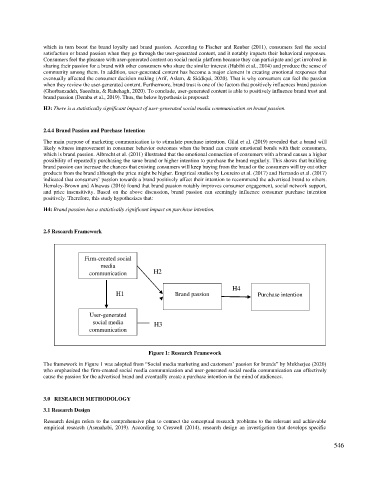
                                                  Figure 1: Research Framework
               The framework in Figure 1 was adopted from “Social media marketing and customers’ passion for brands” by Mukherjee (2020)
               who emphasized the firm-created social media communication and user-generated social media communication can effectively
               cause the passion for the advertised brand and eventually create a purchase intention in the mind of audiences.


               3.0  RESEARCH METHODOLOGY
               3.1 Research Design
                Research design refers to the comprehensive plan to connect the conceptual research problems to the relevant and achievable
                empirical  research  (Asenahabi, 2019). According  to  Creswell (2014), research  design  an  investigation  that develops  specific


                                                                                                               546

