


Page 617 - MARSIUM'21 COMP OF PAPER
P. 617
596                                        Nur Fazira & Dr Adaviah (2022)

                    2.3.2 RESEARCH FRAMEWORK MODEL

                             INDEPENDENT VARIABLES

                               PRIVACY & SECURITY                                               DEPENDENT VARIABLE
                                                             H1

                                   RELIABILITY            H2
                                                                        FACTORS OF E-
                                 RESPONSIVENESS          H3           SERVICE QUALITY                CUSTOMER
                                                          H4         OF ONLINE BANKING              SATISFACTION

                                SITE ORGANIZATION          H5


                                    EFFICIENCY

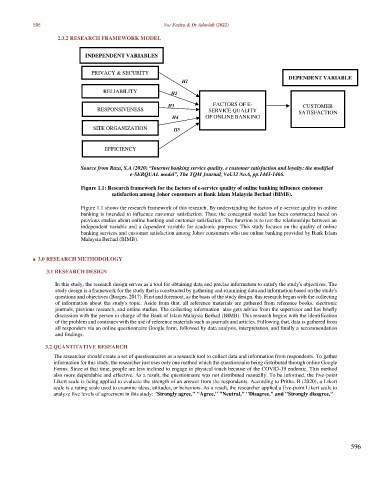
                            Source from Raza, S.A (2020) “Internet banking service quality, e customer satisfaction and loyalty: the modified
                                            e-SERQUAL model”, The TQM Journal, Vol.32 No.6, pp.1443-1466.

                            Figure 1.1: Research framework for the factors of e-service quality of online banking influence customer
                                      satisfaction among Johor consumers at Bank Islam Malaysia Berhad (BIMB).

                            Figure 1.1 shows the research framework of this research. By understanding the factors of e-service quality in online
                            banking is intended to influence customer satisfaction. Thus, the conceptual model has been constructed based on
                            previous studies about online banking and customer satisfaction. The function is to test the relationships between an
                            independent variable and a dependent variable for academic purposes. This study focuses on the quality of online
                            banking services and customer satisfaction among Johor consumers who use online banking provided by Bank Islam
                            Malaysia Berhad (BIMB).


            ■  3.0 RESEARCH METHODOLOGY

                3.1 RESEARCH DESIGN

                   In this study, the research design serves as a tool for obtaining data and precise information to satisfy the study's objectives. The
                   study design is a framework for the study that is constructed by gathering and examining data and information based on the study's
                   questions and objectives (Borges, 2017). First and foremost, as the basis of the study design, this research began with the collecting
                   of information about the study's topic. Aside from that, all reference materials are gathered from reference books, electronic
                   journals, previous research, and online studies. The collecting information  also gets advice from the supervisor and has briefly
                   discussion with the person in charge of the Bank of Islam Malaysia Berhad (BIMB). This research begins with the identification
                   of the problem and continues with the use of reference materials such as journals and articles. Following that, data is gathered from
                   all responders via an online questionnaire Google form, followed by data analysis, interpretation, and finally a recommendation
                   and findings.

                3.2 QUANTITATIVE RESEARCH
                   The researcher should create a set of questionnaires as a research tool to collect data and information from respondents. To gather
                   information for this study, the researcher just uses only one method which the questionnaire being distributed through online Google
                   Forms. Since at that time, people are less inclined to engage in physical touch because of the COVID-19 endemic. This method
                   also more dependable and effective. As a result, the questionnaire was not distributed manually. To be informed, the five- point
                   Likert scale is being applied to evaluate the strength of an answer from the respondents. According to Pritha. B (2020), a Likert
                   scale is a rating scale used to examine ideas, attitudes, or behaviors. As a result, the researcher applied a five-point Likert scale to
                   analyze five levels of agreement in this study: "Strongly agree," "Agree," "Neutral," "Disagree," and "Strongly disagree."


                                                                                                                     596

