


Page 619 - MARSIUM'21 COMP OF PAPER
P. 619
598                                        Nur Fazira & Dr Adaviah (2022)

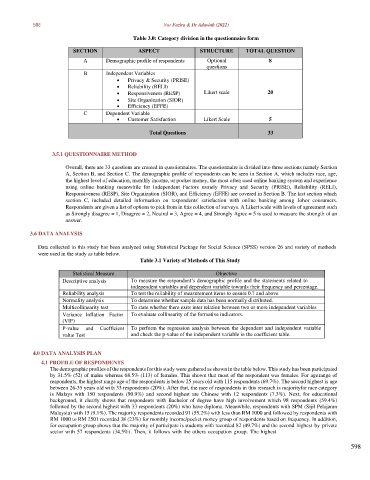
                                             Table 3.0: Category division in the questionnaire form

                         SECTION               ASPECT              STRUCTURE      TOTAL QUESTION
                             A      Demographic profile of respondents   Optional         8
                                                                     questions
                             B      Independent Variables
                                        •   Privacy & Security (PRISE)
                                        •   Reliability (RELI)
                                        •   Responsiveness (RESP)    Likert scale         20
                                        •   Site Organization (SIOR)
                                        •   Efficiency (EFFE)
                             C      Dependent Variable
                                        •   Customer Satisfaction   Likert Scale          5

                                                  Total Questions                         33


                  3.5.1 QUESTIONNAIRE METHOD

                       Overall, there are 33 questions are created in questionnaires. The questionnaire is divided into three sections namely Section
                       A, Section B, and Section C. The demographic profile of respondents can be seen in Section A, which includes race, age,
                       the highest level of education, monthly income, or pocket money, the most often used online banking system and experience
                       using  online  banking  meanwhile  for  Independent  Factors  namely  Privacy  and  Security  (PRISE),  Reliability  (RELI),
                       Responsiveness (RESP), Site Organization (SIOR), and Efficiency (EFFE) are covered in Section B. The last section which
                       section  C,  included  detailed  information  on  respondents'  satisfaction  with  online  banking  among  Johor  consumers.
                       Respondents are given a list of options to pick from in this collection of surveys. A Likert scale with levels of agreement such
                       as Strongly disagree = 1, Disagree = 2, Neutral = 3, Agree = 4, and Strongly Agree = 5 is used to measure the strength of an
                       answer.

           3.6 DATA ANALYSIS

              Data collected in this study has been analyzed using Statistical Package for Social Science (SPSS) version 26 and variety of methods
              were used in the study as table below.
                                               Table 3.1 Variety of Methods of This Study

                         Statistical Measure                            Objective
                      Descriptive analysis   To measure the respondent’s demographic profile and the statements related to
                                            independent variables and dependent variable towards their frequency and percentage.
                      Reliability analysis   To test the reliability of measurement items to ensure 0.7 and above
                      Normality analysis    To determine whether sample data has been normally distributed.
                      Multicollinearity test   To state whether there exits inter relation between two or more independent variables
                      Variance  Inflation   Factor   To evaluate collinearity of the formative indicators.
                      (VIF)
                      P-value  and  Coefficient  To perform the regression analysis between the dependent and independent variable
                      value Test            and check the p-value of the independent variable in the coefficient table.

            4.0 DATA ANALYSIS PLAN
               4.1 PROFILE OF RESPONDENTS
                  The demographic profiles of the respondents for this study were gathered as shown in the table below. This study has been participated
                  by 31.5% (52) of males whereas 68.5% (113) of females. This shown that most of the respondent was females. For age range of
                  respondents, the highest range age of the respondents is below 25 years old with 115 respondents (69.7%). The second highest is age
                  between 26-35 years old with 33 respondents (20%). After that, the race of respondents in this research is majority for race category
                  is  Malays  with  150  respondents  (90.9%)  and  second  highest  are  Chinese  with  12  respondents  (7.3%).  Next,  for  educational
                  background,  it  clearly  shows  that  respondents  with  Bachelor  of  degree  have  high  involvement  which  98  respondents  (59.4%)
                  followed by the second highest with 33 respondents (20%) who have diploma. Meanwhile, respondents with SPM (Sijil Pelajaran
                  Malaysia) with 15 (9.1%). The majority respondents recorded 91 (55.2%) with less than RM 1000 and followed by respondents with
                  RM 1000 to RM 2501 recorded 38 (23%) for monthly income/pocket money group of respondents based on frequency. In addition,
                  for occupation group shows that the majority of participate is students with recorded 82 (49.7%) and the second highest by  private
                  sector with 57 respondents (34.5%). Then, it  follows with the others occupation group.  The highest


                                                                                                                     598

