


Page 633 - MARSIUM'21 COMP OF PAPER
P. 633
612

               a buyer decides to purchase something, he or she will think of a brand that could possibly fulfill their wants. If a customer is well-
               informed about the brand, the customer will have more purchasing possibilities and have better economic decisions.

               H 3: Brand awareness will significantly affect traveler's visiting intention.

               2.7.4 WORD-OF-MOUTH AND PURCHASING INTENTION

                   A customer’s purchase intention usually hinges on various factors like customer’s product interest, forced social pressure from
               others and general perception of what they will receive. In the current technology era, customers have more exposure and could share
               their purchase information with others which influence on a brand purchase decision (Vahdati, & Mousavi, 2016). Electronic word of
               mouth can be found in online consumer reviews and social networks which help to determine the purchase intention of the products or
               services mentioned has been acknowledged by consumers (Fan & Miao, 2012). According to Hutter, et.al. (2013), WOM includes both
               positive and negative information of the brand to others. Hence, businesses need to make sure that every customer have a positive
               experience in order to generate positive word-of-mouth that will eventually affect the purchasing intention of potential consumers.
               Therefore, following hypothesis was generated:

               H 4: Word-of-mouth activities will significantly affect traveler's visiting intention.

            2.8 RESEARCH FRAMEWORK MODEL


                                    Brand Awareness


                                       Brand Page
                                      Commitment

                                                                                 Visit Intention

                                     Word-of-mouth


                                       Annoyance


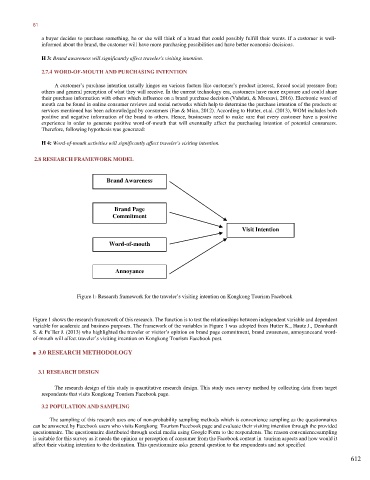
                          Figure 1: Research framework for the traveler’s visiting intention on Kongkong Tourism Facebook


            Figure 1 shows the research framework of this research. The function is to test the relationships between independent variable and dependent
            variable for academic and business purposes. The framework of the variables in Figure 1 was adopted from Hutter K., Hautz J., Dennhardt
            S. & Fu¨ller J. (2013) who highlighted the traveler or visitor’s opinion on brand page commitment, brand awareness, annoyance and word-
            of-mouth will affect traveler’s visiting intention on Kongkong Tourism Facebook post.

            ■  3.0 RESEARCH METHODOLOGY


              3.1 RESEARCH DESIGN

                   The research design of this study is quantitative research design. This study uses survey method by collecting data from target
               respondents that visits Kongkong Tourism Facebook page.

               3.2 POPULATION AND SAMPLING

                 The sampling of this research uses one of non-probability sampling methods which is convenience sampling as the questionnaires
            can be answered by Facebook users who visits Kongkong  Tourism Facebook page and evaluate their visiting intention through the provided
            questionnaire. The questionnaire distributed through social media using Google Form to the respondents. The reason convenience sampling
            is suitable for this survey as it needs the opinion or perception of consumer from the Facebook content in  tourism aspects and how would it
            affect their visiting intention to the destination. This questionnaire asks general question to the respondents and not specified

                                                                                                                     612

