


Page 635 - MARSIUM'21 COMP OF PAPER
P. 635
614

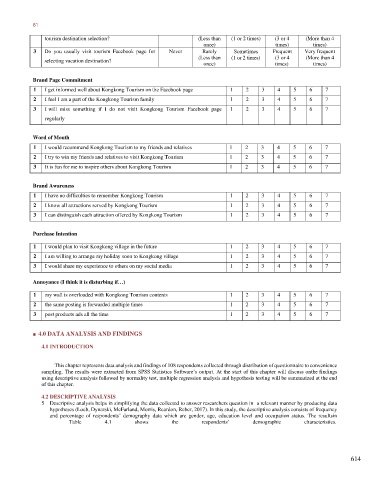
                tourism destination selection?                     (Less than   (1 or 2 times)   (3 or 4   (More than 4
                                                                    once)                   times)       times)
            3   Do  you  usually  visit  tourism  Facebook  page  for   Never   Rarely   Sometimes   Frequent   Very frequent
                                                                   (Less than   (1 or 2 times)   (3 or 4   (More than 4
                selecting vacation destination?
                                                                    once)                   times)       times)

            Brand Page Commitment

            1   I get informed well about Kongkong Tourism on the Facebook page   1   2   3   4   5    6     7
            2   I feel I am a part of the Kongkong Tourism family            1    2     3    4    5    6     7
            3   I will  miss  something  if  I  do  not  visit  Kongkong  Tourism  Facebook  page   1   2   3   4   5   6   7
                regularly

            Word of Mouth

            1   I would recommend Kongkong Tourism to my friends and relatives   1   2   3   4    5    6     7
            2   I try to win my friends and relatives to visit Kongkong Tourism   1   2   3   4   5    6     7
            3   It is fun for me to inspire others about Kongkong Tourism    1    2    3     4    5    6     7

            Brand Awareness

            1   I have no difficulties to remember Kongkong Tourism          1    2     3    4    5    6     7
            2   I know all attractions served by Kongkong Tourism            1    2     3    4    5    6     7
            3   I can distinguish each attraction offered by Kongkong Tourism   1   2   3    4    5    6     7

            Purchase Intention

            1   I would plan to visit Kongkong village in the future         1    2     3    4    5    6     7
            2   I am willing to arrange my holiday soon to Kongkong village   1   2     3    4    5    6     7
            3   I would share my experience to others on my social media     1    2     3    4    5    6     7

            Annoyance (I think it is disturbing if…)

            1   my wall is overloaded with Kongkong Tourism contents         1    2     3    4    5    6     7
            2   the same posting is forwarded multiple times                 1    2     3    4    5    6     7
            3   post products ads all the time                               1    2     3    4    5    6     7

            ■  4.0 DATA ANALYSIS AND FINDINGS

               4.1 INTRODUCTION


                   This chapter represents data analysis and findings of 108 respondents collected through distribution of questionnaire to convenience
               sampling. The results were extracted from SPSS Statistics Software’s output. At the start of this chapter will discuss on the findings
               using descriptive analysis followed by normality test, multiple regression analysis and hypothesis testing will be summarized at the end
               of this chapter.

               4.2 DESCRIPTIVE ANALYSIS
               5  Descriptive analysis helps in simplifying the data collected to answer researchers question in  a relevant manner by producing data
                  hypotheses (Loeb, Dynarski, McFarland, Morris, Reardon, Reber, 2017). In this study, the descriptive analysis consists of frequency
                  and  percentage  of  respondents’  demography  data  which  are  gender,  age,  education  level  and  occupation  status.  The  results in
                        Table       4.1       shows       the       respondents’     demographic      characteristics.


                                                                                                                     614

