


Page 745 - MARSIUM'21 COMP OF PAPER
P. 745
724

             2.3 Research Framework Model

                     Independent Variable


                       Direct Marketing
                                                                         Dependent variable

                        Social media
                                                                             Consumer buying
                                                                                 behavior


                        Advertising


                       Sales promotion


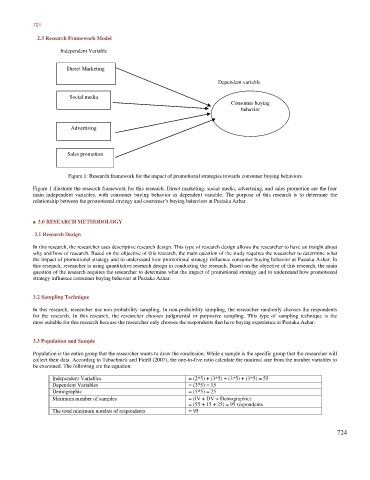
                        Figure 1: Research framework for the impact of promotional strategies towards consumer buying behaviors

            Figure 1 illustrate the research framework for this research. Direct marketing, social media, advertising, and sales promotion are the four
            main  independent  variables,  with  consumer  buying  behavior  as  dependent  variable.  The  purpose  of  this  research  is  to  determine  the
            relationship between the promotional strategy and consumer’s buying behaviors at Pustaka Azhar.


            ■  3.0 RESEARCH METHODOLOGY

            3.1 Research Design

            In this research, the researcher uses descriptive research design. This type of research design allows the researcher to have an insight about
            why and how of research. Based on the objective of this research, the main question of the study requires the researcher to determine what
            the impact of promotional strategy and to understand how promotional strategy influence consumer buying behavior at Pustaka Azhar. In
            this research, researcher is using quantitative research design in conducting the research. Based on the objective of this research, the main
            question of the research requires the researcher to determine what the impact of promotional strategy and to understand how promotional
            strategy influence consumer buying behavior at Pustaka Azhar.


            3.2 Sampling Technique

            In this research, researcher use non-probability sampling. In non-probability sampling, the researcher randomly chooses the respondents
            for  the  research.  In  this  research,  the  researcher  chooses  judgmental  or  purposive  sampling.  This  type  of  sampling  technique  is  the
            most suitable for this research because the researcher only chooses the respondents that have buying experience at Pustaka Azhar.


            3.3 Population and Sample

            Population is the entire group that the researcher wants to draw the conclusion. While a sample is the specific group that the researcher will
            collect their data. According to Tabachnick and Fidell (2007), the one-to-five ratio calculate the minimal size from the number variables to
            be examined. The following are the equation:

                  Independent Variables                        = (2*5) + (3*5) + (3*5) + (3*5) = 55
                  Dependent Variables                          = (3*5) = 15
                  Demographic                                  = (5*5) = 25
                  Minimum number of samples                    = (IV + DV + Demographic)
                                                               = (55 + 15 + 25) = 95 respondents
                  The total minimum number of respondents      = 95


                                                                                                                 724

