


Page 747 - MARSIUM'21 COMP OF PAPER
P. 747
726

            4.2 Descriptive analysis

                                                                          Frequency           Percentage
                  Gender                 Male                                55                 44.7
                                         Female                              68                 55.3
                  Age                    16 - 25 years old                   47                 38.2
                                         26 - 35 years old                   36                 29.3
                                         36 - 45 years old                   20                 16.3
                                         46 years and above                  20                 16.3
                  Education Level        PT3/ SPM                            30                 24.4
                                         STPM/ Diploma/ A-Level              43                 35.0
                                         Bachelor’s degree                   42                 34.1
                                         Master/ MBA                          5                  4.1
                                         PhD                                  3                  2.4
                  Occupation             Student                             40                 32.5
                                         Employed                            72                 58.5
                                         Unemployed                           8                  6.5
                                         Retired                              3                  2.4
                  Monthly Income         Less than RM 1000                   46                 37.4
                                         RM 1001 - RM 2000                   34                 27.6
                                         RM 2001 - RM 3000                   19                 15.4
                                         RM 3001 - RM 4000                   11                  8.9
                                         RM 4001 and above                   13                 10.6

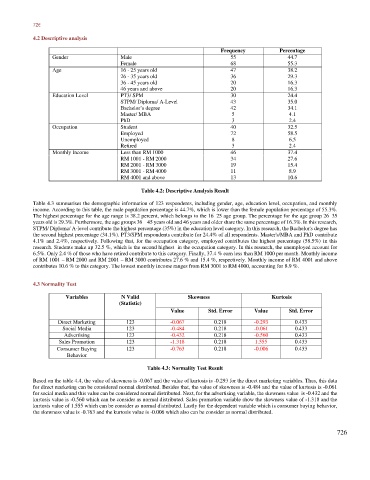
                                                Table 4.2: Descriptive Analysis Result

            Table 4.3 summarises the demographic information of 123 respondents, including gender, age, education level, occupation, and monthly
            income. According to this table, the male population percentage is 44.7%, which is lower than the female population percentage of 55.3%.
            The highest percentage for the age range is 38.2 percent, which belongs to the 16–25 age group. The percentage for the age group 26–35
            years old is 29.3%. Furthermore, the age groups 36 – 45 years old and 46 years and older share the same percentage of 16.3%. In this research,
            STPM/ Diploma/ A-level contribute the highest percentage (35%) in the education level category. In this research, the Bachelor's degree has
            the second highest percentage (34.1%). PT3/SPM respondents contribute for 24.4% of all respondents. Master's/MBA and PhD contribute
            4.1% and 2.4%, respectively. Following that, for the occupation category, employed contributes the highest percentage (58.5%) in this
            research. Students make up 32.5 %, which is the second highest  in the occupation category. In this research, the unemployed account for
            6.5%. Only 2.4 % of those who have retired contribute to this category. Finally, 37.4 % earn less than RM 1000 per month. Monthly income
            of RM 1001 – RM 2000 and RM 2001 – RM 3000 contributes 27.6 % and 15.4 %, respectively. Monthly income of RM 4001 and above
            contributes 10.6 % to this category. The lowest monthly income ranges from RM 3001 to RM 4000, accounting for 8.9 %.

            4.3 Normality Test

                       Variables         N Valid               Skewness                    Kurtosis
                                        (Statistic)
                                                         Value        Std. Error     Value       Std. Error
                    Direct Marketing       123           -0.067         0.218        -0.293        0.433
                      Social Media         123           -0.484         0.218        -0.061        0.433
                      Advertising          123           -0.432         0.218        -0.560        0.433
                     Sales Promotion       123           -1.318         0.218        1.555         0.433
                    Consumer Buying        123           -0.763         0.218        -0.006        0.433
                       Behavior

                                                  Table 4.3: Normality Test Result

            Based on the table 4.4, the value of skewness is -0.067 and the value of kurtosis is -0.293 for the direct marketing variables. Thus, this data
            for direct marketing can be considered normal distributed. Besides that, the value of skewness is -0.484 and the value of kurtosis is -0.061
            for social media and this value can be considered normal distributed. Next, for the advertising variable, the skewness value  is -0.432 and the
            kurtosis value is -0.560 which can be consider as normal distributed. Sales promotion variable show the skewness value of -1.318 and the
            kurtosis value of 1.555 which can be consider as normal distributed. Lastly for the dependent variable which is consumer buying behavior,
            the skewness value is -0.763 and the kurtosis value is -0.006 which also can be consider as normal distributed.


                                                                                                                 726

