


Page 883 - MARSIUM'21 COMP OF PAPER
P. 883
884


               4.2     RESPONDENTS BACKGROUND

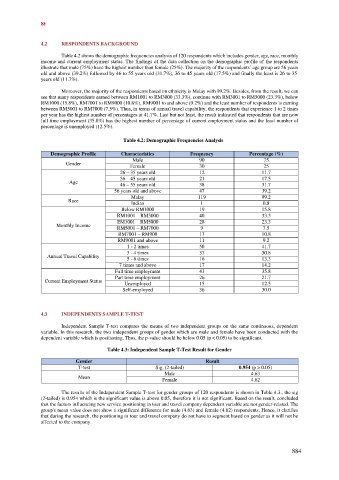
                       Table 4.2 shows the demographic frequencies analysis of 120 respondents which includes gender, age, race, monthly
               income and current employment status. The findings of the data collection on the demographic profile of the respondents
               illustrate that male (75%) have the highest number than female (25%). The majority of the respondents’ age group are 56 years
               old and above (39.2%) followed by 46 to 55 years old (31.7%), 36 to 45 years old (17.5%) and finally the least is 26 to 35
               years old (11.7%).

                       Moreover, the majority of the respondents based on ethnicity is Malay with 99.2%. Besides, from the result, we can
               see that many respondents earned between RM1001 to RM3000 (33.3%), continue with RM3001 to RM5000 (23.3%), below
               RM1000 (15.8%), RM7001 to RM9000 (10.8%), RM9001 to and above (9.2%) and the least number of respondents is earning
               between RM5001 to RM7000 (7.5%). Thus, in terms of annual travel capability, the respondents that experience 1 to 2 times
               per year has the highest number of percentages at 41.7%. Last but not least, the result indicated that respondents that are now
               full time employment (35.8%) has the highest number of percentage of current employment status and the least number of
               percentage is unemployed (12.5%).

                                            Table 4.2: Demographic Frequencies Analysis

                   Demographic Profile      Characteristics         Frequency            Percentage (%)
                                                Male                   90                     75
                        Gender                 Female                  30                     25
                                           26 – 35 years old           12                    11.7
                         Age               36 – 45 years old           21                    17.5
                                           46 – 55 years old           38                    31.7
                                         56 years old and above        47                    39.2
                                               Malay                   119                   99.2
                         Race                  Indian                  1                     0.8
                                            Below RM1000               19                    15.8
                                          RM1001 – RM3000              40                    33.3
                     Monthly Income       EM3001 – RM5000              28                    23.3
                                          RM5001 – RM7000              9                     7.5
                                           RM7001 – RM900              13                    10.8
                                          RM9001 and above             11                    9.2
                                              1 - 2 times              50                    41.7
                  Annual Travel Capability    3 - 4 times              37                    30.8
                                              5 - 6 times              16                    13.3
                                           7 times and above           17                    14.2
                                         Full time employment          43                    35.8
                 Current Employment Status   Part time employment      26                    21.7
                                                                                             12.5
                                             Unemployed
                                                                       15
                                            Self-employed              36                    30.0


               4.3     INDEPENDENTS SAMPLE T-TEST

                       Independent Sample T-test compares the means of two independent groups on the same continuous, dependent
               variable. In this research, the two independent groups of gender which are male and female have been conducted with the
               dependent variable which is positioning. Thus, the p-value should be below 0.05 (p < 0.05) to be significant.

                                       Table 4.3: Independent Sample T-Test Result for Gender

                            Gender                                       Result
                             T-test                     Sig. (2-tailed)              0.954 (p > 0.05)
                                                           Male                          4.63
                             Mean
                                                          Female                         4.62

                       The results of the Independent Sample T-test for gender groups of 120 respondents is shown in Table 4.3., the sig
               (2-tailed) is 0.954 which is the significant value is above 0.05, therefore it is not significant. Based on the result, concluded
               that the factors influencing new service positioning in tour and travel company dependent variable are not gender-related. The
               group's mean value does not show a significant difference for male (4.63) and female (4.62) respondents. Hence, it clarifies
               that during the research, the positioning in tour and travel company do not have to segment based on gender as it will not be
               affected to the company.


                                                                                                        884

