


Page 881 - MARSIUM'21 COMP OF PAPER
P. 881
882


               2.3     RESEARCH FRAMEWORK MODEL


                              Service Innovation (H1)


                                 Reliability (H2)                                    Positioning


                              Brand Endorsement (H3)


                                Independent Variables                           Dependent Variables


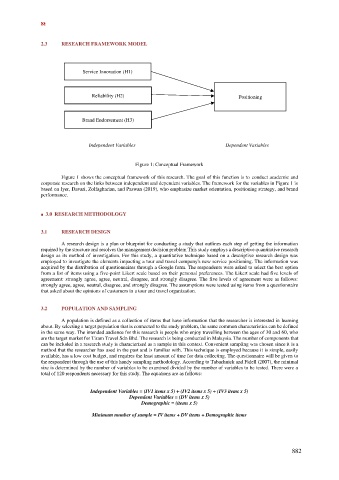
                                                 Figure 1: Conceptual Framework

                       Figure 1 shows the conceptual framework of this research. The goal of this function is to conduct academic and
               corporate research on the links between independent and dependent variables. The framework for the variables in Figure 1 is
               based on Iyer, Davari, Zolfagharian, and Paswan (2019), who emphasize market orientation, positioning strategy, and brand
               performance.


               ■  3.0  RESEARCH METHODOLOGY


               3.1     RESEARCH DESIGN

                       A research design is a plan or blueprint for conducting a study that outlines each step of getting the information
               required by the structure and resolves the management decision problem This study employs a descriptive quantitative research
               design as its method of investigation. For this study, a quantitative technique based on a descriptive research design was
               employed to investigate the elements impacting a tour and travel company's new service positioning. The information was
               acquired by the distribution of questionnaires through a Google form. The respondents were asked to select the best option
               from a list of items using a five-point Likert scale based on their personal preferences. The Likert scale had five levels of
               agreement: strongly agree, agree, neutral, disagree, and strongly disagree. The five levels of agreement were as follows:
               strongly agree, agree, neutral, disagree, and strongly disagree. The assumptions were tested using items from a questionnaire
               that asked about the opinions of customers in a tour and travel organization.


               3.2     POPULATION AND SAMPLING

                       A population is defined as a collection of items that have information that the researcher is interested in learning
               about. By selecting a target population that is connected to the study problem, the same common characteristics can be defined
               in the same way. The intended audience for this research is people who enjoy travelling between the ages of 30 and 60, who
               are the target market for Tiram Travel Sdn Bhd. The research is being conducted in Malaysia. The number of components that
               can be included in a research study is characterized as a sample in this context. Convenient sampling was chosen since it is a
               method that the researcher has used in the past and is familiar with. This technique is employed because it is simple, easily
               available, has a low cost budget, and requires the least amount of time for data collecting. The questionnaire will be given to
               the respondent through the use of this handy sampling methodology. According to Tabachnick and Fidell (2007), the minimal
               size is determined by the number of variables to be examined divided by the number of variables to be tested. There were a
               total of 120 respondents necessary for this study. The equations are as follows:


                                 Independent Variables = (IV1 items x 5) + (IV2 items x 5) + (IV3 items x 5)
                                              Dependent Variables = (DV items x 5)
                                                   Demographic = (items x 5)

                                 Minimum number of sample = IV items + DV items + Demographic items


                                                                                                        882

