


Page 882 - MARSIUM'21 COMP OF PAPER
P. 882
883


               3.3     RESEARCH INSTRUMENT

                       The use of a quantitative method, such as Likert scale questions, was deemed to be the most appropriate approach
               for this study. The questionnaire is divided into three sections, which are referred to as parts A, B, and C. Part A consists of
               six straightforward questions about the demographic profile of those who answered them. The independent variables, which
               included service innovation, customer segmentation, and brand endorsement, were covered in 15 questions in Part B. Finally,
               Part C had five measurement items that were related to dependent variables, which was the positioning of the subject. Each of
               the questions in the collection of surveys asks the respondents to select one option from a list. The purpose of a Likert scale is
               to determine the strength of an answer, with levels of agreement ranging from strongly agree to agree, neutral to disagree, and
               strongly disagree to severely disagree.


               ■  4.0  FINDING AND ANALYSIS


               4.1     DATA ANALYSIS

                       This study's data was analysed using the IBM Statistical Package for Social Science (SPSS) version 27. SPSS is a
               well-known  software  application  that  is  used  to  test  the  relationship  between  independent  variables  (service  innovation,
               reliability, and brand endorsement) and dependent variables (positioning of tour and travel company). The frequencies analysis
               was used to analyze the demographic information given by the respondents and the results reflect on what the data is or means.
               Hence, by summarizing in tables it helps to understand the descriptive analysis background and the distribution of the data.
               The data analysis was carried out in two stages, of which the first stage involved examining the measuring model and the
               second stage consisted of the construction of a complete structural equation model (Dhiman et al., 2019). The data was analysed
               using a normality test, reliability analysis, descriptive statistics, multiple regressions and one-way ANOVA test.

                  The first stage is to measure the normality test and reliability test. Data normality (the approval range of skewing is ± 1)
               was assessed based on skewness and kurtosis tests. Cronbach’s alpha was used to assess the inner accuracy of problems related
               to the Likert scale. Variance from 0 to 7 is widely reckoned to signify the internal stability of the findings (Pallant, 2005). In
               the second stage followed by Multiple Linear Regression. Multiple Linear  Regression analysis, which refers to the most
               commonly used method to analyze quantitative data, had been carried out as it is an incredibly powerful pool to determines
               which correlations among the variables had the most significant effect and prediction (Ghauri et al., 2020). The higher the R2;
               the higher is the percentage of variation of the dependent variable explained by the independent variables. When the p-value
               is less than 0.05, Multiple Linear Regression is significant (Lee et al., 2018). The results of the regression would be to determine
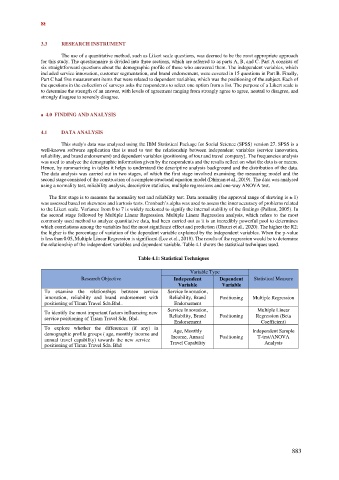
               the relationship of the independent variables and dependent variable. Table 4.1 shows the statistical techniques used.

                                                  Table 4.1: Statistical Techniques

                                                                    Variable Type
                              Research Objective              Independent     Dependent   Statistical Measure
                                                                Variable       Variable
                 To  examine  the  relationships  between  service   Service Innovation,
                 innovation,  reliability  and  brand  endorsement  with   Reliability, Brand   Positioning   Multiple Regression
                 positioning of Tiram Travel Sdn.Bhd..        Endorsement
                 To identify the most important factors influencing new   Service Innovation,      Multiple Linear
                 service positioning of Tiram Travel Sdn. Bhd.   Reliability, Brand   Positioning   Regression (Beta
                                                              Endorsement                    Coefficient)
                 To  explore  whether  the  differences  (if  any)  in   Age, Monthly      Independent Sample
                 demographic profile groups ( age, monthly income and   Income, Annual   Positioning   T-test/ANOVA
                 annual  travel  capability)  towards  the new  service
                 positioning of Tiram Travel Sdn. Bhd        Travel Capability                Analysis


                                                                                                        883

