


Page 896 - MARSIUM'21 COMP OF PAPER
P. 896
897                                        Tam & Adaviah (2022)

               males and 26.8 thousand (49%) females. In this study, since the respondents were only customers of the pharmacy, purposive sampling
               techniques were used to select samples from the population. Questionnaires will be distributed to the respondents by using sample-to-
               variable ratio sampling (Memon et al., 2020). “The sample-to-variable ratio suggests a minimum observation-to-variable ratio of 5:1, but
               ratios of 15:1 or 20:1 are preferred” (Hair et al., 2018). Based on a five-to-one ratio, the calculation of the minimum sample size is the
               multiple of all variables used in this study. Calculation as below:

                  Independent variable : (7 dimension with total of 21 items) x 5
                                 : 21 x 5 = 105
                  Dependent variable  : ( 7 items x 5)
                                 : 7 x 5 = 35
                  Total respondents under sample to variable ratio : 105 + 35 = 140

               Minimum of 140 respondents were required to conduct this study by referring to the calculation above. After the distribution process,
               the researchers managed to collect more than the minimum number of 140 respondents and archive 155 respondents. The questionnaire
               was developed to be distributed in two ways, which are online and offline methods. The offline method is distributed manually to
               respondents whereas the online method is to convert the questionnaire into an online survey using Google Forms and distribute the form
               through social media.

               3.3 RESEARCH INSTRUMENT

                   The use of quantitative methods (likert scale questions) was considered to be the most appropriate for this study. The questionnaire
               consists of three parts, which include Part A, Part B and Part C. Part A contains 21 questions on all dimension elements. Meanwhile,
               Part B was asked about consumer satisfaction. Finally, Section C includes five simple questions about respondents' information. This set
               of questionnaires asked respondents to tick from given choices. Respondents were asked to rank the importance of these items on a scale
               of 1 to 5 based on their satisfaction with them. (1 = Totally Satisfied, 2 = Satisfied, 3 = Neutral, 4 = Dissatisfied, and 5 = Totally
               Dissatisfied.)

            ■  4.0 DATA ANALYSIS

               4.1  Profile of Respondents

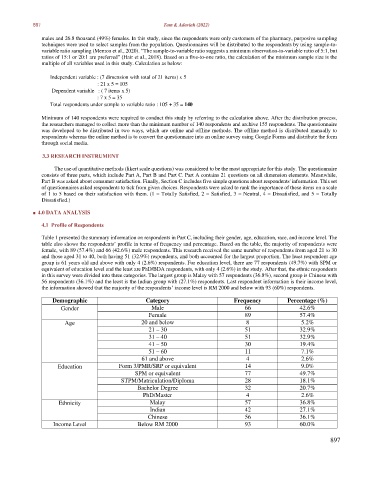
               Table 1 presented the summary information on respondents in Part C, including their gender, age, education, race, and income level. The
               table also shows the respondents’ profile in terms of frequency and percentage. Based on the table, the majority of respondents were
               female, with 89 (57.4%) and 66 (42.6%) male respondents. This research received the same number of respondents from aged 21 to 30
               and those aged 31 to 40, both having 51 (32.9%) respondents, and both accounted for the largest proportion. The least respondent age
               group is 61 years old and above with only 4 (2.6%) respondents. For education level, there are 77 respondents (49.7%) with SPM or
               equivalent of education level and the least are PhD/BDA respondents, with only 4 (2.6%) in the study. After that, the ethnic respondents
               in this survey were divided into three categories. The largest group is Malay with 57 respondents (36.8%), second group is Chinese with
               56 respondents (36.1%) and the least is the Indian group with (27.1%) respondents. Last respondent information is their income level,
               the information showed that the majority of the respondents’ income level is RM 2000 and below with 93 (60%) respondents.

                  Demographic                    Category                     Frequency         Percentage (%)
                     Gender                        Male                           66                42.6%
                                                  Female                          89                57.4%
                      Age                       20 and below                      8                  5.2%
                                                  21 – 30                         51                32.9%
                                                  31 – 40                         51                32.9%
                                                  41 – 50                         30                19.4%
                                                  51 – 60                         11                 7.1%
                                                61 and above                      4                  2.6%
                    Education           Form 3/PMR/SRP or equivalent              14                 9.0%
                                              SPM or equivalent                   77                49.7%
                                         STPM/Matriculation/Diploma               28                18.1%
                                              Bachelor Degree                     32                20.7%
                                                PhD/Master                        4                  2.6%
                    Ethnicity                      Malay                          57                36.8%
                                                   Indian                         42                27.1%
                                                  Chinese                         56                36.1%
                   Income Level                Below RM 2000                      93                60.0%

                                                                                                              897

