


Page 898 - MARSIUM'21 COMP OF PAPER
P. 898
899                                        Tam & Adaviah (2022)

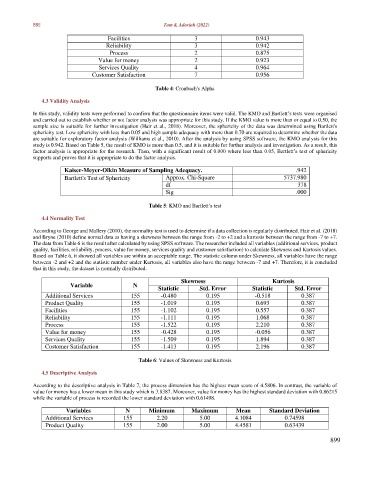
                                     Facilities                  3                    0.943
                                    Reliability                  3                    0.942
                                     Process                     2                    0.875
                                  Value for money                2                    0.923
                                  Services Quality               4                    0.964
                                Customer Satisfaction            7                    0.956

                                                    Table 4: Cronbach's Alpha

               4.3 Validity Analysis

            In this study, validity tests were performed to confirm that the questionnaire items were valid. The KMO and Bartlett’s tests were organised
            and carried out to establish whether or not factor analysis was appropriate for this study. If the KMO value is more than or equal to 0.50, the
            sample size is suitable for further investigation (Hair et al., 2018). Moreover, the sphericity of the data was determined using Bartlett's
            sphericity test. Low sphericity with less than 0.05 and high sample adequacy with more than 0.70 are required to determine whether the data
            are suitable for exploratory factor analysis (Williams et al., 2010). After the analysis by using SPSS software, the KMO analysis for this
            study is 0.942. Based on Table 5, the result of KMO is more than 0.5, and it is suitable for further analysis and investigation. As a result, this
            factor analysis is appropriate for the research. Then, with a significant result of 0.000 where less than 0.05, Bartlett’s test of sphericity
            supports and proves that it is appropriate to do the factor analysis.

                      Kaiser-Meyer-Olkin Measure of Sampling Adequacy.                             .942
                      Bartlett's Test of Sphericity     Approx. Chi-Square                     5737.980
                                                        df                                         378
                                                        Sig                                        .000

                                                  Table 5: KMO and Bartlett’s test

               4.4 Normality Test

            According to George and Mallery (2010), the normality test is used to determine if a data collection is regularly distributed. Hair et al. (2018)
            and Bryne (2010) define normal data as having a skewness between the range from -2 to +2 and a kurtosis between the range from -7 to +7.
            The data from Table 6 is the result after calculated by using SPSS software. The researcher included all variables (additional services, product
            quality, facilities, reliability, process, value for money, services quality and customer satisfaction) to calculate Skewness and Kurtosis values.
            Based on Table 6, it showed all variables are within an acceptable range. The statistic column under Skewness, all variables have the range
            between -2 and +2 and the statistic number under Kurtosis, all variables also have the range between -7 and +7. Therefore, it is concluded
            that in this study, the dataset is normally distributed.

                                                             Skewness                      Kurtosis
                        Variable             N
                                                     Statistic     Std. Error       Statistic      Std. Error
                Additional Services         155       -0.480         0.195           -0.518          0.387
                Product Quality             155       -1.019         0.195            0.693          0.387
                Facilities                  155       -1.102         0.195            0.557          0.387
                Reliability                 155       -1.111         0.195            1.068          0.387
                Process                     155       -1.522         0.195            2.210          0.387
                Value for money             155       -0.428         0.195           -0.056          0.387
                Services Quality            155       -1.509         0.195            1.894          0.387
                Customer Satisfaction       155       -1.413         0.195            2.196          0.387

                                               Table 6: Values of Skewness and Kurtosis

               4.5 Descriptive Analysis

            According to the descriptive analysis in Table 7, the process dimension has the highest mean score of 4.5806. In contrast, the variable of
            value for money has a lower mean in this study which is 3.8387. Moreover, value for money has the highest standard deviation with 0.86215
            while the variable of process is recorded the lower standard deviation with 0.61498.

                       Variables           N      Minimum       Maximum        Mean       Standard Deviation
                Additional Services       155        2.20          5.00        4.1084          0.74598
                Product Quality           155        2.00          5.00        4.4581          0.63439

                                                                                                              899

