


Page 231 - Account 10
P. 231
B.  Deductions From Salary
              At the end of every month, salary and allowances are distributed to the employees
          of an office for the duties performed by them during the month. Some amounts as per the
         rules and regulations and/or as the request of an employee are deducted from out of the
         salary. Personnel provident fund (employees’ provident fund), income tax, tejarath sapati
         (personnel loan), clearance of advance remained in the name of a certain employee, as
         his request or according to the rules and regulations etc. are some common examples of
         such deductions. The important deductions are introduced below with their accounting
         treatment.

          i.   Personnel Provident Fund
              It  is  that  fund,  which  is  raised  by  collecting  the  compulsory  deduction  from  the
          salary of the permanent employees of a government office, company or corporation. The
          employer office contributes the cent percent of the deduction to the fund. In Nepal, the
          personnel provident fund deduction is 10% of the total regular (monthly) salary and the
          employer office contributes the cent percent of the deduction to the fund.
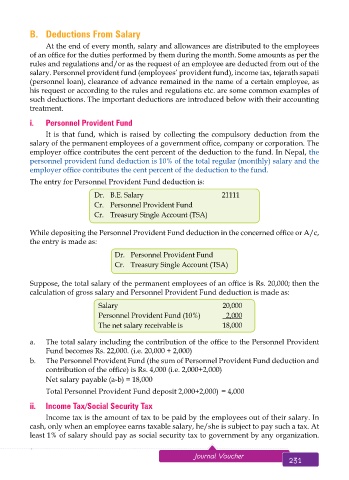
          The entry for Personnel Provident Fund deduction is:

                            Dr.   B.E. Salary                   21111
                            Cr.   Personnel Provident Fund
                            Cr.   Treasury Single Account (TSA)

          While depositing the Personnel Provident Fund deduction in the concerned office or A/c,
         the entry is made as:
                                  Dr.   Personnel Provident Fund
                                  Cr.   Treasury Single Account (TSA)

          Suppose, the total salary of the permanent employees of an office is Rs. 20,000; then the
         calculation of gross salary and Personnel Provident Fund deduction is made as:
                             Salary                             20,000
                             Personnel Provident Fund (10%)        2,000
                             The net salary receivable is       18,000

          a.   The total salary including the contribution of the office to the Personnel Provident
              Fund becomes Rs. 22,000. (i.e. 20,000 + 2,000)
          b.   The Personnel Provident Fund (the sum of Personnel Provident Fund deduction and
              contribution of the office) is Rs. 4,000 (i.e. 2,000+2,000)
              Net salary payable (a-b) = 18,000
              Total Personnel Provident Fund deposit 2,000+2,000) = 4,000

          ii.  Income Tax/Social Security Tax
              Income tax is the amount of tax to be paid by the employees out of their salary. In
         cash, only when an employee earns taxable salary, he/she is subject to pay such a tax. At
         least 1% of salary should pay as social security tax to government by any organization.


 230  Aakar’s Office Practice and Accountancy - 10      Journal Voucher            231

