


Page 138 - Health, Population and Environment Education 9
P. 138
Surface water
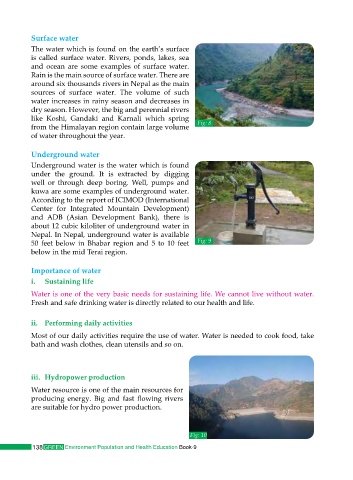
          The water which is found on the earth’s surface
          is called surface water. Rivers, ponds, lakes, sea
          and ocean are some  examples of surface water.
          Rain is the main source of surface water. There are
          around six thousands rivers in Nepal as the main
          sources of surface water. The volume of such
          water increases in rainy season and decreases in
          dry season. However, the big and perennial rivers
          like  Koshi, Gandaki and Karnali which spring   Fig: 8
          from the Himalayan region contain large volume
          of water throughout the year.

          Underground water
          Underground water is the water which is found
          under the ground. It is extracted by digging
          well or through deep boring. Well, pumps and
          kuwa are some examples of underground water.
          According to the report of ICIMOD (International
          Center  for Integrated  Mountain  Development)
          and  ADB (Asian Development  Bank), there  is
          about 12 cubic kiloliter of underground water in
          Nepal. In Nepal, underground water is available
          50 feet below in Bhabar region and 5 to 10 feet   Fig: 9
          below in the mid Terai region.

          Importance of water
          i.   Sustaining life
          Water is one of the very basic needs for sustaining life. We cannot live without water.
          Fresh and safe drinking water is directly related to our health and life.


          ii.  Performing daily activities
          Most of our daily activities require the use of water. Water is needed to cook food, take
          bath and wash clothes, clean utensils and so on.


          iii.  Hydropower production
          Water resource is one of the main resources for
          producing  energy.  Big  and  fast  flowing  rivers
          are suitable for hydro power production.


                                                        Fig: 10
          138  GREEN Environment Population and Health Education Book-9

