


Page 140 - Health, Population and Environment Education 9
P. 140
mixture of silt, clay and loam. The soil in this region is loose and fragile which is more
          exposed to erosion. However, the soil of this region is more fertile and of better quality
          than that of the mountain region.


          Terai region
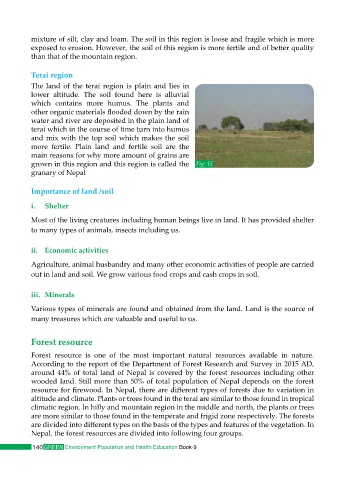
          The  land of  the terai region is  plain and  lies in
          lower altitude. The soil found here is alluvial
          which contains more humus. The plants and
          other organic materials flooded down by the rain
          water and river are deposited in the plain land of
          terai which in the course of time turn into humus
          and mix with the top soil which makes the soil
          more  fertile. Plain land and fertile soil are the
          main reasons for why more amount of grains are
          grown in this region and this region is called the  Fig: 15
          granary of Nepal


          Importance of land /soil
          i.  Shelter

          Most of the living creatures including human beings live in land. It has provided shelter
          to many types of animals, insects including us.

          ii.  Economic activities

          Agriculture, animal husbandry and many other economic activities of people are carried
          out in land and soil. We grow various food crops and cash crops in soil.


          iii.  Minerals
          Various types of minerals are found and obtained from the land. Land is the source of
          many treasures which are valuable and useful to us.


          Forest resource

          Forest resource is one of the most important  natural  resources available  in nature.
          According to the report of the Department of Forest Research and Survey in 2015 AD,
          around  44% of total land of Nepal is  covered by the forest resources  including other
          wooded land. Still more than 50% of total population of Nepal depends on the forest
          resource for firewood. In Nepal, there are different types of forests due to variation in
          altitude and climate. Plants or trees found in the terai are similar to those found in tropical
          climatic region. In hilly and mountain region in the middle and north, the plants or trees
          are more similar to those found in the temperate and frigid zone respectively. The forests
          are divided into different types on the basis of the types and features of the vegetation. In
          Nepal, the forest resources are divided into following four groups.
          140  GREEN Environment Population and Health Education Book-9

