


Page 143 - Health, Population and Environment Education 9
P. 143
species of fish in Nepal. Nepal is also the habitat of the bird only found in Nepal called
            Spiny babbler. Similarly, many endangered animals like Bengal tiger, One- horned rhino,
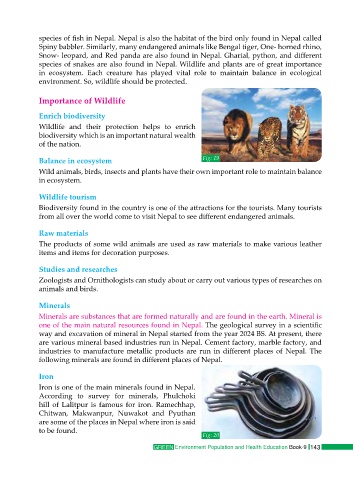
            Snow- leopard, and Red panda are also found in Nepal. Gharial, python, and different
            species of snakes are also found in Nepal. Wildlife and plants are of great importance
            in ecosystem.  Each  creature has  played  vital role to maintain balance in ecological
            environment. So, wildlife should be protected.

            Importance of Wildlife

            Enrich biodiversity
            Wildlife and their  protection helps to enrich
            biodiversity which is an important natural wealth
            of the nation.

            Balance in ecosystem                            Fig: 19
            Wild animals, birds, insects and plants have their own important role to maintain balance
            in ecosystem.

            Wildlife tourism
            Biodiversity found in the country is one of the attractions for the tourists. Many tourists
            from all over the world come to visit Nepal to see different endangered animals.

            Raw materials
            The products of some wild animals are used as raw materials to make various leather
            items and items for decoration purposes.

            Studies and researches
            Zoologists and Ornithologists can study about or carry out various types of researches on
            animals and birds.
            Minerals
            Minerals are substances that are formed naturally and are found in the earth. Mineral is
            one of the main natural resources found in Nepal. The geological survey in a scientific
            way and excavation of mineral in Nepal started from the year 2024 BS. At present, there
            are various mineral based industries run in Nepal. Cement factory, marble factory, and
            industries  to  manufacture  metallic  products  are  run  in  different  places  of  Nepal.  The
            following minerals are found in different places of Nepal.

            Iron
            Iron is one of the main minerals found in Nepal.
            According to survey for minerals, Phulchoki
            hill of Lalitpur is famous  for iron. Ramechhap,
            Chitwan, Makwanpur, Nuwakot and Pyuthan
            are some of the places in Nepal where iron is said
            to be found.
                                                            Fig: 20
                                              GREEN  Environment Population and Health Education Book-9 143

