


Page 57 - Health, Population and Environment Education 9
P. 57
Activity: 3

             Collect the latest data on HDI of different countries in the world. Discuss in a group on
             comparative study of HDI value of different countries and present in a class.


             3.3   Concept of Human Resource Development

            Introduction

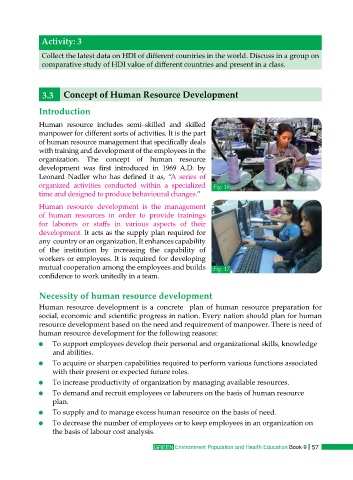
            Human resource  includes semi–skilled  and skilled
            manpower for different sorts of activities. It is the part
            of human resource management that specifically deals
            with training and development of the employees in the
            organization.  The  concept of human  resource
            development  was  first  introduced  in  1969  A.D.  by
            Leonard  Nadler  who  has  defined  it  as,  “A series of
            organized  activities conducted within a  specialized  Fig: 16
            time and designed to produce behavioural changes.”
            Human resource development is the management
            of human resources in order to provide trainings
            for  laborers  or  staffs  in  various  aspects  of  their
            development. It acts as the supply plan required for
            any  country or an organization. It enhances capability
            of the institution by increasing the capability of
            workers or employees. It is required for developing
            mutual cooperation among the employees and builds  Fig: 17
            confidence to work unitedly in a team.

            Necessity of human resource development

            Human resource  development is  a concrete   plan of human resource  preparation for
            social, economic and scientific progress in nation. Every nation should plan for human
            resource development based on the need and requirement of manpower. There is need of
            human resource development for the following reasons:
                 To support employees develop their personal and organizational skills, knowledge
                and abilities.
                 To acquire or sharpen capabilities required to perform various functions associated
                with their present or expected future roles.
                 To increase productivity of organization by managing available resources.
                 To demand and recruit employees or labourers on the basis of human resource
                plan.
                 To supply and to manage excess human resource on the basis of need.
                To decrease the number of employees or to keep employees in an organization on
                the basis of labour cost analysis.

                                              GREEN  Environment Population and Health Education Book-9 57

