


Page 65 - Health, Population and Environment Education 9
P. 65
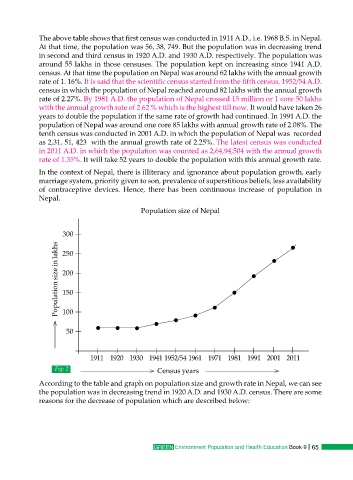
The above table shows that first census was conducted in 1911 A.D., i.e. 1968 B.S. in Nepal.
            At that time, the population was 56, 38, 749. But the population was in decreasing trend
            in second and third census in 1920 A.D. and 1930 A.D. respectively. The population was
            around 55 lakhs in those censuses. The population kept on increasing since 1941 A.D.
            census. At that time the population on Nepal was around 62 lakhs with the annual growth
            rate of 1. 16%. It is said that the scientific census started from the fifth census, 1952/54 A.D.
            census in which the population of Nepal reached around 82 lakhs with the annual growth
            rate of 2.27%. By 1981 A.D. the population of Nepal crossed 15 million or 1 core 50 lakhs
            with the annual growth rate of 2.62 % which is the highest till now. It would have taken 26
            years to double the population if the same rate of growth had continued. In 1991 A.D. the
            population of Nepal was around one core 85 lakhs with annual growth rate of 2.08%. The
            tenth census was conducted in 2001 A.D. in which the population of Nepal was  recorded
            as 2,31, 51, 423  with the annual growth rate of 2.25%. The latest census was conducted
            in 2011 A.D. in which the population was counted as 2,64,94,504 with the annual growth
            rate of 1.35%. It will take 52 years to double the population with this annual growth rate.
            In the context of Nepal, there is illiteracy and ignorance about population growth, early
            marriage system, priority given to son, prevalence of superstitious beliefs, less availability
            of contraceptive devices. Hence, there  has been  continuous increase of population in
            Nepal.
                                          Population size of Nepal


                   300
                  Population size in lakhs   200

                   250


                   150


                   100

                    50


                           1911 1920 1930 1941 1952/54 1961 1971 1981 1991 2001 2011
                 Fig: 2                        Census years

            According to the table and graph on population size and growth rate in Nepal, we can see
            the population was in decreasing trend in 1920 A.D. and 1930 A.D. census. There are some
            reasons for the decrease of population which are described below:


                                              GREEN  Environment Population and Health Education Book-9 65

