


Page 66 - Health, Population and Environment Education 9
P. 66
a.  False enumeration
          The first scientific census started in Nepal only from 1952/54  A.D. onwards. During the
          census period of 1920 A.D. and 1930 A.D there was no use of modern means and methods
          in census. So, it is guessed that the calculation of population might be wrong and the
          population was shown less.

          b.  Lack of health services and health manpower
          During 1920 and 1930 A.D., our country was very backward and was not as developed as it
          is today. There was lack of health services, proper management system, health manpower
          and treatment procedures in almost all parts of Nepal. People had no availability  of
          treatment for their health problems. Many people used to die due to lack of health services
          and treatment of diseases. As a result, there was decrease in population.


          c.  Spreading of epidemics
          In the decades of 1920 and 1930 A.D., there was spreading of epidemics like tuberculosis,
          malaria, influenza, small pox, etc. in many parts of the country. As health facilities were
          not easily available, people would lose their life. Even people of that time had no idea
          about proper cleanliness and sanitation. As as result, many people used to die due to
          spreading of epidemics which resulted in decrease in population.


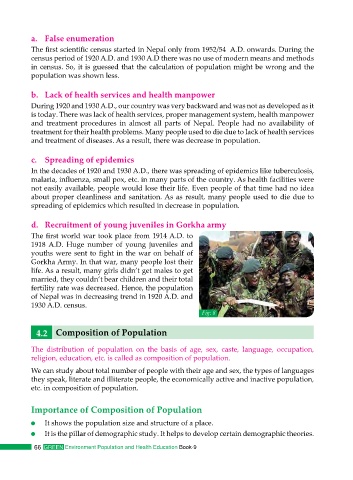
          d.  Recruitment of young juveniles in Gorkha army
          The first world war took place from 1914 A.D. to
          1918  A.D. Huge number of young juveniles and
          youths were sent to fight in the war on behalf of
          Gorkha Army. In that war, many people lost their
          life. As a result, many girls didn’t get males to get
          married, they couldn’t bear children and their total
          fertility rate was decreased. Hence, the population
          of Nepal was in decreasing trend in 1920 A.D. and
          1930 A.D. census.
                                                            Fig: 8

            4.2  Composition of Population

          The distribution of population on the basis of age, sex, caste, language, occupation,
          religion, education, etc. is called as composition of population.
          We can study about total number of people with their age and sex, the types of languages
          they speak, literate and illiterate people, the economically active and inactive population,
          etc. in composition of population.

          Importance of Composition of Population

              It shows the population size and structure of a place.
              It is the pillar of demographic study. It helps to develop certain demographic theories.
           66  GREEN Environment Population and Health Education Book-9

