


Page 199 - 9 teachers social book 9 @ 2077 ctp_Neat
P. 199
determinants of precipitation, temperature, humidity, air pressure, wind and other
          meteorological variables in the given area or region. Weather is an integral part of
          climate.  The  same latitude sometime create  differences  in  climate because  of  the
          altitude. For example, the summer temperature of Nepalgunj is about 30°C whereas
          it is only 12°C in Namchhebazar. Though different types of climates are formed in
          Nepal,  there  is  great  influence  of  monsoon  in  it.  The  three  geographic  regions  of
          Nepal have distinct climate, features according to their attitudinal positions. Broadly,
          Nepal’s climate is divided into two categories.


          1.  Summer Season


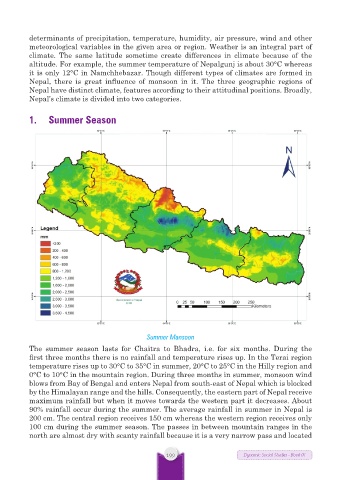
                                            Summer Mansoon

          The summer season lasts for Chaitra to Bhadra, i.e. for six months. During  the
          first three months there is no rainfall and temperature rises up. In the Terai region
          temperature rises up to 30°C to 35°C in summer, 20°C to 25°C in the Hilly region and
          0°C to 10°C in the mountain region. During three months in summer, monsoon wind
          blows from Bay of Bengal and enters Nepal from south-east of Nepal which is blocked
          by the Himalayan range and the hills. Consequently, the eastern part of Nepal receive
          maximum rainfall but when it moves towards the western part it decreases. About
          90% rainfall occur during the summer. The average rainfall in summer in Nepal is
          200 cm. The central region receives 150 cm whereas the western region receives only
          100 cm during the summer season. The passes in between mountain ranges in the
          north are almost dry with scanty rainfall because it is a very narrow pass and located


                                                 199                    Dynamic Social Studies - Book IX

