


Page 50 - 9 teachers social book 9 @ 2077 ctp_Neat
P. 50
university. Non-formal education is the way to gain knowledge skill and efficiency
           through adult literacy classes, seminars, skills, etc.
           Similarly, informal education means to learn something from daily experience
           of life. In such education there are no written books to learn. It teaches the life’s
           lesson.  Education sharpens the mind and makes people knowledgeable, conscious,
           disciplined, systematic, innovative, productive, diligent and professional.


           Education in Nepal

           The education system prevalent in the past was Gurukul Education System. In this
           system the education was imparted from religious scripts. Students who were called
           Shishyas attained education by visiting the Ashram of the Guru and gained religious
           as well as moral education. Such system was called as Gurukul System. There were no
           system of fees but students had to pay services to Gurus as gratitude. The development
           in education could be seen. Gradually, the children of the Royal family started gaining
           education by hiring teachers in the places. They also gained religious education from
           the Vedas, the Upanishad, the Ramayana, the Gita, etc. as moral education.

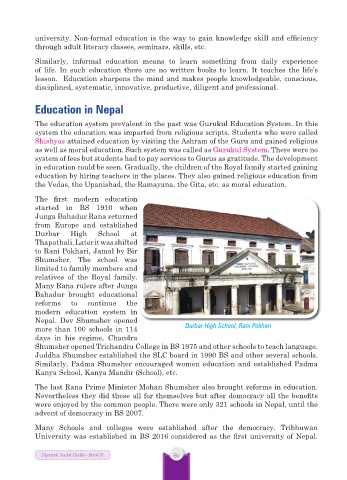
           The  first  modern  education
           started in  BS  1910 when
           Junga Bahadur Rana returned
           from  Europe  and established
           Durbar     High    School   at
           Thapathali. Later it was shifted
           to Rani Pokhari, Jamal by Bir
           Shumsher.  The school  was
           limited to family members and
           relatives of the Royal  family.
           Many Rana rulers after Junga
           Bahadur brought educational
           reforms    to   continue   the
           modern education system  in
           Nepal. Dev Shumsher  opened
           more than 100 schools in 114                Durbar High School, Rani Pokhari
           days in his regime, Chandra
           Shumsher opened Trichandra College in BS 1975 and other schools to teach language.
           Juddha Shumsher established the SLC board in 1990 BS and other several schools.
           Similarly, Padma Shumsher encouraged women education and established Padma
           Kanya School, Kanya Mandir (School), etc.

           The last Rana Prime Minister Mohan Shumsher also brought reforms in education.
           Nevertheless they did these all for themselves but after democracy all the benefits
           were enjoyed by the common people. There were only 321 schools in Nepal, until the
           advent of democracy in BS 2007.

           Many Schools and colleges were established after the democracy. Tribhuwan
           University was established in BS 2016 considered as the first university of Nepal.

             Dynamic Social Studies - Book IX      50

