


Page 24 - Office Practice and Accounting 10
P. 24
or records on a common basis is called the classification of files. The main objective
          of filing is to provide the required papers and documents easily and quickly at the
          time of necessity. To achieve this objective, it is essential to classify various papers and
          documents in such a way that they are made easily available. By proper classification
          the required files and documents can be located quickly and easily.
          The easy location of record depends upon how carefully they have been kept. If the
          documents related to a particular heading or subject have been classified properly
          under one head, these can be easily located. Another benefit of classification is that
          letters classified under the same head need similar kind of protection and maintenance
          and their life span is also the same. The common and popular classification method of
          filing are explained below.


          1.    Alphabetical classification
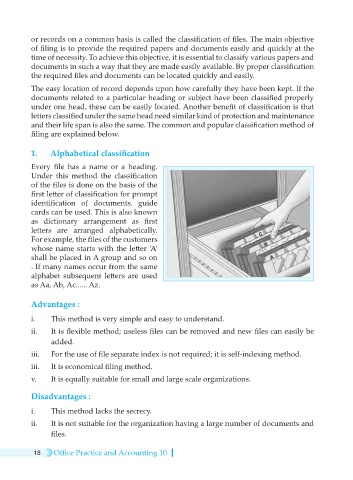
          Every  file  has  a  name  or  a  heading.
          Under  this  method  the  classification
          of the files is done on the basis of the
          first letter of classification for prompt
          identification  of  documents,  guide
          cards can be used. This is also known
          as  dictionary  arrangement  as  first
          letters  are  arranged  alphabetically.
          For example, the files of the customers
          whose name starts with the letter ‘A’
          shall be placed in A group and so on
          . If many names occur from the same
          alphabet  subsequent  letters  are  used
          as Aa, Ab, Ac...... Az.

          Advantages :

          i.    This method is very simple and easy to understand.
          ii.   It is flexible method; useless files can be removed and new files can easily be
                added.
          iii.   For the use of file separate index is not required; it is self-indexing method.

          iii.   It is economical filing method.
          v.    It is equally suitable for small and large scale organizations.

          Disadvantages :

          i.    This method lacks the secrecy.
          ii.   It is not suitable for the organization having a large number of documents and
                files.


           18    Office Practice and Accounting 10

