


Page 20 - Math 7
P. 20
Set
U
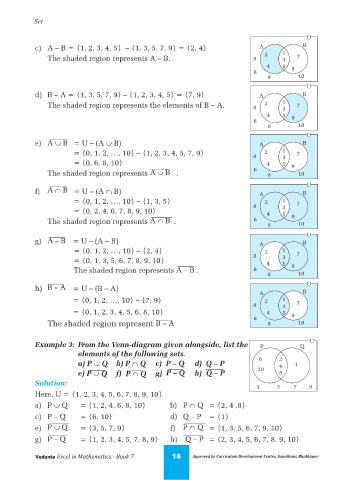
c) A – B = {1, 2, 3, 4, 5} – {1, 3, 5, 7, 9} = {2, 4} A B
The shaded region represents A – B. 0 2 1 7
3
4 5 9
6
8 10
U
d) B – A = {1, 3, 5, 7, 9} – {1, 2, 3, 4, 5} = {7, 9} A B
The shaded region represents the elements of B – A. 0 2 1 7
3
4 5 9
6
8 10
U
e) A B = U – (A B) A B
= {0, 1, 2, …, 10} – {1, 2, 3, 4, 5, 7, 9} 0 2 1 7
3
= {0, 6, 8, 10} 4 5 9
The shaded region represents A B . 6 8 10
U
f) A B = U – (A B) A B
= {0, 1, 2, …, 10} – {1, 3, 5} 2 1 7
= {0, 2, 4, 6, 7, 8, 9, 10} 0 4 3
5
The shaded region represents A B . 6 9
8 10
U
g) A – B = U – (A – B) A B
= {0, 1, 2, …, 10} – {2, 4} 2 1 7
= {0, 1, 3, 5, 6, 7, 8, 9, 10} 0 4 3
5
The shaded region represents A – B . 6 9
8 10
U
h) B – A = U – (B – A)
A B
= {0, 1, 2, …, 10} – {7, 9} 2 1
0 3 7
= {0, 1, 2, 3, 4, 5, 6, 8, 10} 4 5 9
6
The shaded region represent B – A 8 10
Example 3: From the Venn-diagram given alongside, list the P Q U
elements of the following sets.
a) P Q b) P Q c) P – Q d) Q – P 6 2 4 1
e) P Q f) P Q g) P – Q h) Q – P 10 8
Solution:
3 5 7 9
Here, U = {1, 2, 3, 4, 5, 6, 7, 8, 9, 10}
a) P Q = {1, 2, 4, 6, 8, 10} b) P Q = {2, 4 ,8}
c) P – Q = {6, 10} d) Q – P = {1}
e) P Q = {3, 5, 7, 9} f) P Q = {1, 3, 5, 6, 7, 9, 10}
g) P – Q = {1, 2, 3, 4, 5, 7, 8, 9} h) Q – P = {2, 3, 4, 5, 6, 7, 8, 9, 10}
Vedanta Excel in Mathematics - Book 7 18 Approved by Curriculum Development Centre, Sanothimi, Bhaktapur

