


Page 16 - Math 7
P. 16
Set

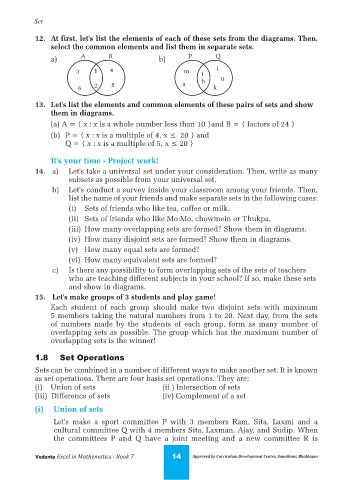
           12.  At first, let's list the elements of each of these sets from the diagrams. Then,
                select the common elements and list them in separate sets.
                a)       A       B             b)       P       Q
                       3    1    4                    m     t   i  n

                        6   2    8                    a     h  k

           13.  Let's list the elements and common elements of these pairs of sets and show
                them in diagrams.
                (a) A = { x : x is a whole number less than 10 }and B = { factors of 24 }
                (b)  P = { x : x is a multiple of 4, x ≤  20 } and
                    Q = { x : x is a multiple of 5, x ≤ 20 }

                It's your time - Project work!
           14.  a)   Let's take a universal set under your consideration. Then, write as many
                     subsets as possible from your universal set.
                b)   Let's conduct a survey inside your classroom among your friends. Then,
                     list the name of your friends and make separate sets in the following cases:
                     (i)  Sets of friends who like tea, coffee or milk.
                     (ii)  Sets of friends who like Mo:Mo, chowmein or Thukpa.
                     (iii)  How many overlapping sets are formed? Show them in diagrams.
                     (iv)  How many disjoint sets are formed? Show them in diagrams.
                     (v)  How many equal sets are formed?
                     (vi)  How many equivalent sets are formed?
                c)   Is there any possibility to form overlapping sets of the sets of teachers
                     who are teaching different subjects in your school? If so, make these sets
                     and show in diagrams.
           15.  Let's make groups of 3 students and play game!
                Each student of each group should make two disjoint sets with maximum
                5 members taking the natural numbers from 1 to 20. Next day, from the sets
                of numbers made by the students of each group, form as many number of
                overlapping sets as possible. The group which has the maximum number of
                overlapping sets is the winner!

           1.8    Set Operations
           Sets can be combined in a number of different ways to make another set. It is known
           as set operations. There are four basis set operations. They are:
           (i)    Union of sets                 (ii ) Intersection of sets
           (iii)  Difference of sets            (iv) Complement of a set
           (i)  Union of sets

                 Let's make a sport committee P with 3 members Ram, Sita, Laxmi and a
                 cultural committee Q with 4 members Sita, Laxman, Ajay, and Sudip. When
                 the committees P and Q have a joint meeting and a new committee R is

           Vedanta Excel in Mathematics - Book 7   14    Approved by Curriculum Development Centre, Sanothimi, Bhaktapur

