


Page 17 - Math 7
P. 17
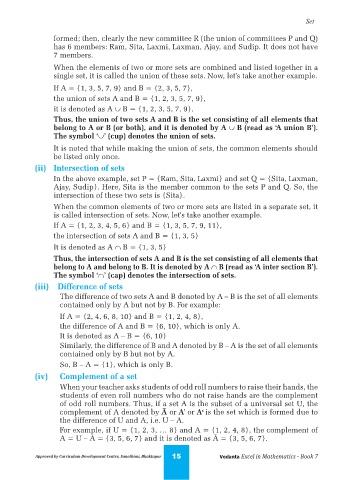
Set
formed; then, clearly the new committee R (the union of committees P and Q)
has 6 members: Ram, Sita, Laxmi, Laxman, Ajay, and Sudip. It does not have
7 members.
When the elements of two or more sets are combined and listed together in a
single set, it is called the union of these sets. Now, let's take another example.
If A = {1, 3, 5, 7, 9} and B = {2, 3, 5, 7},
the union of sets A and B = {1, 2, 3, 5, 7, 9},
it is denoted as A B = {1, 2, 3, 5, 7, 9}.
Thus, the union of two sets A and B is the set consisting of all elements that
belong to A or B (or both), and it is denoted by A B (read as ‘A union B’).
The symbol ‘’ (cup) denotes the union of sets.
It is noted that while making the union of sets, the common elements should
be listed only once.
(ii) Intersection of sets
In the above example, set P = {Ram, Sita, Laxmi} and set Q = {Sita, Laxman,
Ajay, Sudip}. Here, Sita is the member common to the sets P and Q. So, the
intersection of these two sets is {Sita}.
When the common elements of two or more sets are listed in a separate set, it
is called intersection of sets. Now, let's take another example.
If A = {1, 2, 3, 4, 5, 6} and B = {1, 3, 5, 7, 9, 11},
the intersection of sets A and B = {1, 3, 5}
It is denoted as A B = {1, 3, 5}
Thus, the intersection of sets A and B is the set consisting of all elements that
belong to A and belong to B. It is denoted by A B (read as ‘A inter section B’).
The symbol ‘’ (cap) denotes the intersection of sets.
(iii) Difference of sets
The difference of two sets A and B denoted by A – B is the set of all elements
contained only by A but not by B. For example:
If A = {2, 4, 6, 8, 10} and B = {1, 2, 4, 8},
the difference of A and B = {6, 10}, which is only A.
It is denoted as A – B = {6, 10}
Similarly, the difference of B and A denoted by B – A is the set of all elements
contained only by B but not by A.
So, B – A = {1}, which is only B.
(iv) Complement of a set
When your teacher asks students of odd roll numbers to raise their hands, the
students of even roll numbers who do not raise hands are the complement
of odd roll numbers. Thus, if a set A is the subset of a universal set U, the
c
complement of A denoted by A or A' or A is the set which is formed due to
the difference of U and A, i.e. U – A.
For example, if U = {1, 2, 3, … 8} and A = {1, 2, 4, 8}, the complement of
A = U – A = {3, 5, 6, 7} and it is denoted as A = {3, 5, 6, 7}.
Approved by Curriculum Development Centre, Sanothimi, Bhaktapur 15 Vedanta Excel in Mathematics - Book 7

