


Page 38 - Math 7
P. 38
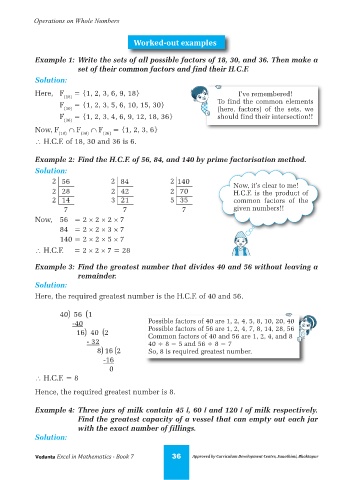
Operations on Whole Numbers
Worked-out examples
Example 1: Write the sets of all possible factors of 18, 30, and 36. Then make a
set of their common factors and find their H.C.F.
Solution:
Here, F = {1, 2, 3, 6, 9, 18} I’ve remembered!
(18)
F = {1, 2, 3, 5, 6, 10, 15, 30} To find the common elements
(30) (here, factors) of the sets, we
F = {1, 2, 3, 4, 6, 9, 12, 18, 36} should find their intersection!!
(36)
Now, F F F = {1, 2, 3, 6}
(18) (30) (36)
? H.C.F. of 18, 30 and 36 is 6.
Example 2: Find the H.C.F. of 56, 84, and 140 by prime factorisation method.
Solution:
2 56 2 84 2 140 Now, it’s clear to me!
2 28 2 42 2 70 H.C.F. is the product of
2 14 3 21 5 35 common factors of the
7 7 7 given numbers!!
Now, 56 = 2 u 2 u 2 u 7
84 = 2 u 2 u 3 u 7
140 = 2 u 2 u 5 u 7
? H.C.F. = 2 u 2 u 7 = 28
Example 3: Find the greatest number that divides 40 and 56 without leaving a
remainder.
Solution:
Here, the required greatest number is the H.C.F. of 40 and 56.
40 56 1
-40 Possible factors of 40 are 1, 2, 4, 5, 8, 10, 20, 40
16 40 2 Possible factors of 56 are 1, 2, 4, 7, 8, 14, 28, 56
Common factors of 40 and 56 are 1, 2, 4, and 8
- 32 40 ÷ 8 = 5 and 56 ÷ 8 = 7
8 16 2 So, 8 is required greatest number.
-16
0
? H.C.F. = 8
Hence, the required greatest number is 8.
Example 4: Three jars of milk contain 45 l, 60 l and 120 l of milk respectively.
Find the greatest capacity of a vessel that can empty out each jar
with the exact number of fillings.
Solution:
Vedanta Excel in Mathematics - Book 7 36 Approved by Curriculum Development Centre, Sanothimi, Bhaktapur

