


Page 41 - Math 7
P. 41
Operations on Whole Numbers
b) Sunayna is making identical balloon arrangements for a party. She has 56
orange balloons, 40 maroon balloons, and 24 white balloon. She wants each
arrangement to have the same number of each colour. What is the greatest
number of arrangements that she can make if no balloon is left over? Also
find the shares of each coloured balloon.
c) Find the greatest number of old people of a geriatric care centre to whom
50 sweaters, 75 kambals, and 100 warm jackets can be equally distributed.
Also, find the share of each item among them.
d) There are 21 apples, 28 pears, and 49 oranges. These are to be arranged in
heaps containing the same number of fruits. Find the greatest number of
fruits possible to keep in each heap. How many heaps are formed by this
arrangement?
3.5 Lowest common multiple ( L.C.M)
Let’s take, M and M as the sets of a few multiples of 6 and 9 respectively.
6
9
Here, M = {6, 12, 18, 24, 30, 36, 42, 48, 54, 60, ...}
6
M = { 9, 18, 27, 36, 45, 54, 63, 72, 81, 90,...}
9
Now, let’s make another set A of the common multiples of M and M ,
6 9
A = M M = { 18, 36, 54, ...}
6 9
Among these common multiples, 18 is the lowest one. So, 18 is called the Lowest
Common Multiple (L.C.M.) of 6 and 9.
Thus, the lowest common Multiples (LCM) of two or more natural numbers is the
least natural number which is exactly divided by the given numbers.
3.6 Finding L.C.M. by Factorisation Method
In this method, we should find the prime factors of the given numbers. Then the
product of the common prime factors and the remaining prime factors (which are
not common) is the L.C.M. of the given numbers. For example:
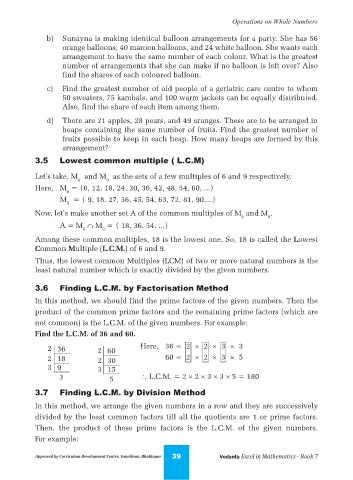
Find the L.C.M. of 36 and 60.
2 36 2 60 Here, 36 = 2 u 2 u 3 u 3
2 18 2 30 60 = 2 u 2 u 3 u 5
3 9 3 15
3 5 ? L.C.M. = 2 u 2 u 3 u 3 u 5 = 180
3.7 Finding L.C.M. by Division Method
In this method, we arrange the given numbers in a row and they are successively
divided by the least common factors till all the quotients are 1 or prime factors.
Then, the product of these prime factors is the L.C.M. of the given numbers.
For example:
Approved by Curriculum Development Centre, Sanothimi, Bhaktapur 39 Vedanta Excel in Mathematics - Book 7

