


Page 45 - Math 7
P. 45
Operations on Whole Numbers

           12. a)  Let's take two call bells and mark them as A and B. Now, let's do the following
                   activities and answer the given questions.
                   (i)   Let's ring both the bells at a time and see at what time you rang the bell.
                   (ii)  Then, ring bell A after each interval of 2 minutes and bell B after each
                        interval of 3 minutes. In this way, after how many minutes do you ring
                        both the bells at a time?
                   (iii)  Again, ring bell A in every 4 minutes intervals and bell B in every 6
                        minutes intervals.
                        In this way, after how many minutes do you ring both the bells at a
                        time? Now, did you understand one of the uses of L.C.M. in our real life
                        situations?

               b)  Let's take any two pairs of composite numbers between 5 and 15.
                   (i)   Let's find the H.C.F. and L.C.M. of each pair of your composite numbers.
                   (ii)  Find the product of H.C.F. and L.C.M. of each pair of numbers. Also,
                        find the product of each pair of numbers.
                   Could you investigate a fact about the H.C.F. and L.C.M. of any pair of
                   numbers? Write a report about it and discuss in the class.
           3.8     Square and square root

           Prefect square numbers

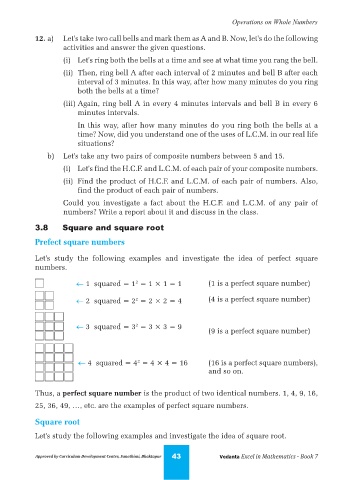
           Let's study the following examples and investigate the idea of perfect square
           numbers.

                       m 1  squared = 1  = 1 × 1 = 1          (1 is a perfect square number)
                                        2
                       m 2  squared = 2  = 2 × 2 = 4          (4 is a perfect square number)
                                        2

                       m 3  squared = 3  = 3 × 3 = 9
                                        2
                                                              (9 is a perfect square number)


                        m 4  squared = 4  = 4 × 4 = 16        (16 is a perfect square numbers),
                                         2
                                                              and so on.

           Thus, a perfect square number is the product of two identical numbers. 1, 4, 9, 16,

           25, 36, 49, …, etc. are the examples of perfect square numbers.

           Square root
           Let's study the following examples and investigate the idea of square root.


           Approved by Curriculum Development Centre, Sanothimi, Bhaktapur  43  Vedanta Excel in Mathematics - Book 7

