


Page 131 - Health, Population and Environment Education 10
P. 131
Habitat: Sarpagandha is found in the hilly and terai region of Nepal upto an altitude
            of 1200 m . It is found in less number in the sal forest. It is protected in Makalu Barun
            National Park.
            Useful Parts: The roots are used for making medicines which are used to treat blood
            pressure, reduce pain,  diarrhoea, dysentery and to induce sleep.

            iv.   Lauth Salla (Himalayan yew)
            Scientific Name: Taxus wallichiana

            Description of the plant: It is a plant of pine species. It is
            a cone bearing plant with comb-like leaves. It is about 8
            meters tall. It can reproduce through the stems and roots.
            It produces a chemical known as taxol. Taxol is used to
            cure immature cancer. It produces poisonous fruits.
            Habitat: It is found at an altitudinal range of 1700 to 3400  m.
            It is found  in the mid  and  western regions of  Nepal. It
            is protected in Sagarmatha National Park and Langtang   Fig: 21
            National Park.
            Useful parts: Its leaves are used to extract taxol which is used to cure immature cancer. It
            can also be used to prepare medicines for the treatment of intestinal diseases, headache,
            respiratory tract inflection, diarrhoea, high blood pressure and dry cough.

            v.   Panchaunle (Orchid)
            Scientific Name: Dactylorhiza hatageria

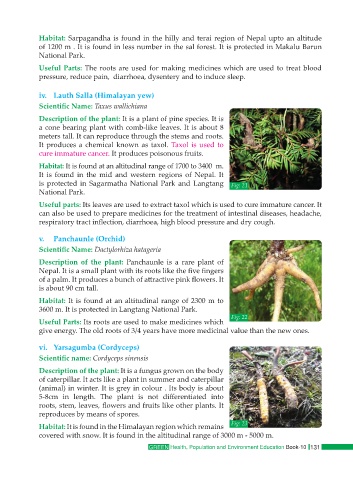
            Description of  the plant:  Panchaunle is a rare plant  of
            Nepal. It is a small plant with its roots like the five fingers
            of a palm. It produces a bunch of attractive pink flowers. It
            is about 90 cm tall.

            Habitat: It is found at an altitudinal range of 2300 m to
            3600 m. It is protected in Langtang National Park.
                                                                    Fig: 22
            Useful Parts: Its roots are used to make medicines which
            give energy. The old roots of 3/4 years have more medicinal value than the new ones.

            vi.   Yarsagumba (Cordyceps)
            Scientific name: Cordyceps sinensis
            Description of the plant: It is a fungus grown on the body
            of caterpillar. It acts like a plant in summer and caterpillar
            (animal) in winter. It is grey in colour . Its body is about
            5-8cm  in  length.  The  plant  is  not  differentiated  into
            roots, stem, leaves, flowers and fruits like other plants. It
            reproduces by means of spores.
            Habitat: It is found in the Himalayan region which remains   Fig: 23
            covered with snow. It is found in the altitudinal range of 3000 m - 5000 m.
                                            GREEN  Health, Population and Environment Education Book-10 131

