


Page 127 - Health, Population and Environment Education 10
P. 127
vi.  Giant Pied Hornbill
            Scientific name: Buceros bicornis

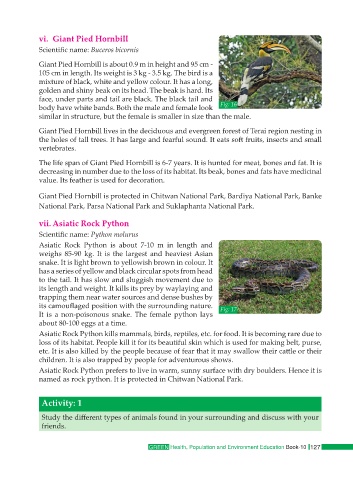
            Giant Pied Hornbill is about 0.9 m in height and 95 cm -
            105 cm in length. Its weight is 3 kg - 3.5 kg. The bird is a
            mixture of black, white and yellow colour. It has a long,
            golden and shiny beak on its head. The beak is hard. Its
            face, under parts and tail are black. The black tail and
            body have white bands. Both the male and female look   Fig: 16
            similar in structure, but the female is smaller in size than the male.

            Giant Pied Hornbill lives in the deciduous and evergreen forest of Terai region nesting in
            the holes of tall trees. It has large and fearful sound. It eats soft fruits, insects and small
            vertebrates.

            The life span of Giant Pied Hornbill is 6-7 years. It is hunted for meat, bones and fat. It is
            decreasing in number due to the loss of its habitat. Its beak, bones and fats have medicinal
            value. Its feather is used for decoration.

            Giant Pied Hornbill is protected in Chitwan National Park, Bardiya National Park, Banke
            National Park, Parsa National Park and Suklaphanta National Park.


            vii. Asiatic Rock Python
            Scientific name: Python molurus
            Asiatic  Rock  Python  is  about 7-10 m  in length and
            weighs 85-90 kg. It is the largest and heaviest Asian
            snake. It is light brown to yellowish brown in colour. It
            has a series of yellow and black circular spots from head
            to the tail. It has slow and sluggish movement due to
            its length and weight. It kills its prey by waylaying and
            trapping them near water sources and dense bushes by
            its camouflaged position with the surrounding nature.   Fig: 17
            It is a non-poisonous snake. The female python lays
            about 80-100 eggs at a time.
            Asiatic Rock Python kills mammals, birds, reptiles, etc. for food. It is becoming rare due to
            loss of its habitat. People kill it for its beautiful skin which is used for making belt, purse,
            etc. It is also killed by the people because of fear that it may swallow their cattle or their
            children. It is also trapped by people for adventurous shows.
            Asiatic Rock Python prefers to live in warm, sunny surface with dry boulders. Hence it is
            named as rock python. It is protected in Chitwan National Park.


             Activity: 1

             Study the different types of animals found in your surrounding and discuss with your
             friends.


                                            GREEN  Health, Population and Environment Education Book-10 127

