


Page 126 - Health, Population and Environment Education 10
P. 126
iv.  Bengal Tiger
          Scientific name: Panthera tigris

          Bengal tiger is  one of the rare species  of the world.
          According to the survey done in Nepal in 2013 A.D.,
          there are 198 Bengal Tigers above 15 years in Nepal.

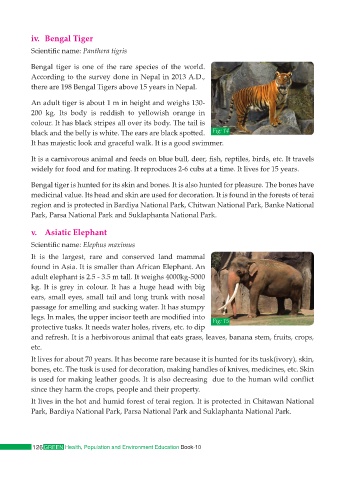
          An adult tiger is about 1 m in height and weighs 130-
          200 kg. Its body is reddish to yellowish orange in
          colour. It has black stripes all over its body. The tail is
          black and the belly is white. The ears are black spotted.   Fig: 14
          It has majestic look and graceful walk. It is a good swimmer.

          It is a carnivorous animal and feeds on blue bull, deer, fish, reptiles, birds, etc. It travels
          widely for food and for mating. It reproduces 2-6 cubs at a time. It lives for 15 years.

          Bengal tiger is hunted for its skin and bones. It is also hunted for pleasure. The bones have
          medicinal value. Its head and skin are used for decoration. It is found in the forests of terai
          region and is protected in Bardiya National Park, Chitwan National Park, Banke National
          Park, Parsa National Park and Suklaphanta National Park.

          v.  Asiatic Elephant

          Scientific name: Elephus maximus
          It is  the largest,  rare and  conserved  land  mammal
          found in Asia. It is smaller than African Elephant. An
          adult elephant is 2.5 - 3.5 m tall. It weighs 4000kg-5000
          kg. It is grey in colour. It has a huge head with big
          ears, small eyes, small tail and long trunk with nosal
          passage for smelling and sucking water. It has stumpy
          legs. In males, the upper incisor teeth are modified into   Fig: 15
          protective tusks. It needs water holes, rivers, etc. to dip
          and refresh. It is a herbivorous animal that eats grass, leaves, banana stem, fruits, crops,
          etc.
          It lives for about 70 years. It has become rare because it is hunted for its tusk(ivory), skin,
          bones, etc. The tusk is used for decoration, making handles of knives, medicines, etc. Skin
          is used for making leather goods. It is also decreasing  due to the human wild conflict
          since they harm the crops, people and their property.
          It lives in the hot and humid forest of terai region. It is protected in Chitawan National
          Park, Bardiya National Park, Parsa National Park and Suklaphanta National Park.


          126  GREEN Health, Population and Environment Education Book-10

