


Page 139 - Health, Population and Environment Education 10
P. 139
7.1  Concept of Disease
            According to Oxford  Advanced Learner’s Dictionary,  a  disease  is  an  illness  affecting
            humans, animals or plants, often caused by infection. Human beings, plants and animals
            have been suffering since their evolution on the earth. So the concept of disease is not
            a new concept. The history of diseases is as long as the history of human beings. The
            unhealthy  condition of human beings  is called disease. We feel uneasy or discomfort
            while suffering from a disease.


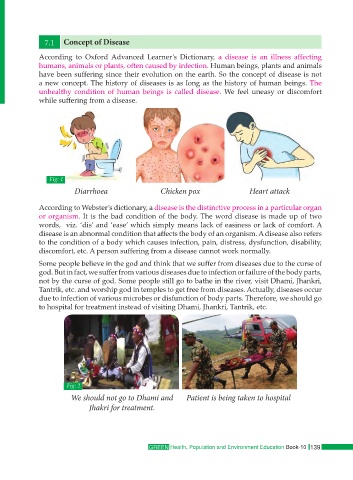
               Fig: 1
                       Diarrhoea                Chicken pox              Heart attack

            According to Webster’s dictionary, a disease is the distinctive process in a particular organ
            or organism. It is the bad condition of the body. The word disease is made up of two
            words,  viz. ‘dis’ and ‘ease’ which simply means lack of easiness or lack of comfort. A
            disease is an abnormal condition that affects the body of an organism. A disease also refers
            to the condition of a body which causes infection, pain, distress, dysfunction, disability,
            discomfort, etc. A person suffering from a disease cannot work normally.
            Some people believe in the god and think that we suffer from diseases due to the curse of
            god. But in fact, we suffer from various diseases due to infection or failure of the body parts,
            not by the curse of god. Some people still go to bathe in the river, visit Dhami, Jhankri,
            Tantrik, etc. and worship god in temples to get free from diseases. Actually, diseases occur
            due to infection of various microbes or disfunction of body parts. Therefore, we should go
            to hospital for treatment instead of visiting Dhami, Jhankri, Tantrik, etc.


                    Fig: 2
                      We should not go to Dhami and    Patient is being taken to hospital
                           Jhakri for treatment.


                                            GREEN  Health, Population and Environment Education Book-10 139

