


Page 140 - Health, Population and Environment Education 10
P. 140
7.2  Types of Diseases
          We suffer from various diseases such as fever, diarrhoea, pneumonia, cancer, tuberculosis,
          asthma, heart attack, polio, common cold, etc. Some diseases transmit from one person
          to another and others do not. On this basis, diseases are mainly of two types. They are as
          follows.
          1.  Communicable diseases
          2.  Non-communicable diseases


          1.  Communicable Diseases

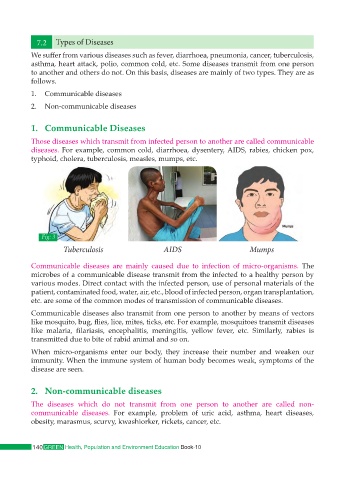
          Those diseases which transmit from infected person to another are called communicable
          diseases. For example, common cold, diarrhoea, dysentery, AIDS, rabies, chicken pox,
          typhoid, cholera, tuberculosis, measles, mumps, etc.


             Fig: 3
                   Tuberculosis                  AIDS                     Mumps

          Communicable  diseases  are mainly caused  due to infection of micro-organisms. The
          microbes of a communicable disease transmit from the infected to a healthy person by
          various modes. Direct contact with the infected person, use of personal materials of the
          patient, contaminated food, water, air, etc., blood of infected person, organ transplantation,
          etc. are some of the common modes of transmission of communicable diseases.
          Communicable diseases also transmit from one person to another by means of vectors
          like mosquito, bug, flies, lice, mites, ticks, etc. For example, mosquitoes transmit diseases
          like  malaria,  filariasis,  encephalitis,  meningitis,  yellow  fever,  etc.  Similarly,  rabies  is
          transmitted due to bite of rabid animal and so on.
          When  micro-organisms  enter our  body,  they increase  their number and  weaken our
          immunity. When the immune system of human body becomes weak, symptoms of the
          disease are seen.


          2.  Non-communicable diseases
          The  diseases  which  do  not transmit from  one  person  to another are  called  non-
          communicable  diseases.  For example, problem  of  uric  acid,  asthma,  heart diseases,
          obesity, marasmus, scurvy, kwashiorker, rickets, cancer, etc.


          140  GREEN Health, Population and Environment Education Book-10

