


Page 37 - Health, Population and Environment Education 10
P. 37
b.   Impact on Terrestrial and Aquatic Ecosystem
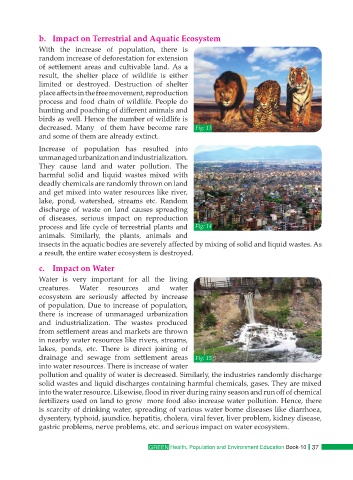
            With the increase of population, there is
            random increase of deforestation for extension
            of  settlement  areas  and  cultivable  land. As  a
            result,  the shelter  place  of  wildlife  is  either
            limited or destroyed. Destruction of shelter
            place affects in the free movement, reproduction
            process and food chain of wildlife. People do
            hunting and poaching of different animals and
            birds as well. Hence the number of wildlife is
            decreased. Many  of them have become rare  Fig: 13
            and some of them are already extinct.
            Increase  of  population has  resulted  into
            unmanaged urbanization and industrialization.
            They cause  land and water pollution. The
            harmful  solid  and  liquid  wastes  mixed  with
            deadly chemicals are randomly thrown on land
            and get mixed into water resources like river,
            lake, pond, watershed, streams  etc. Random
            discharge of waste on land causes spreading
            of diseases,  serious  impact on reproduction
            process and life cycle of terrestrial plants and  Fig: 14
            animals.  Similarly, the plants, animals  and
            insects in the aquatic bodies are severely affected by mixing of solid and liquid wastes. As
            a result, the entire water ecosystem is destroyed.

            c.   Impact on Water
            Water is very important for all the living
            creatures.  Water   resources   and   water
            ecosystem  are  seriously  affected  by  increase
            of population. Due to increase of population,
            there is  increase  of  unmanaged urbanization
            and industrialization. The wastes produced
            from settlement areas and markets are thrown
            in nearby water resources like rivers, streams,
            lakes,  ponds,  etc.  There  is  direct  joining  of
            drainage  and  sewage  from  settlement  areas  Fig: 15
            into water resources. There is increase of water
            pollution and quality of water is decreased. Similarly, the industries randomly discharge
            solid wastes and liquid discharges containing harmful chemicals, gases. They are mixed
            into the water resource. Likewise, flood in river during rainy season and run off of chemical
            fertilizers used on land to grow  more food also increase water pollution. Hence, there
            is scarcity of drinking water, spreading of various water borne diseases like diarrhoea,
            dysentery, typhoid, jaundice, hepatitis, cholera, viral fever, liver problem, kidney disease,
            gastric problems, nerve problems, etc. and serious impact on water ecosystem.


                                            GREEN  Health, Population and Environment Education Book-10 37

