


Page 41 - Health, Population and Environment Education 10
P. 41
Methods of Population Management


                   Direct Method                           Indirect Method
                        Marriage at Appropriate Age            Gender Equality

                        Conception at Appropriate Age          Improvement in Status of
                        Birth Spacing                          Women
                                                               Expansion of Population
                        Legal Abortion
                                                               Education
                        Adoption of Contraceptive
                        Methods and Use of                     Enrollment in Income
                        Contraceptive Devices                  Generation
            The direct and indirect methods of population management are described below:

            Indirect Methods of Population Management
            a.  Gender Equality
            Gender  equality  is  the  maintenance  of  balance
            between son  and  daughter considering  both
            of  them  have  equal  existence.  It  is  the  freedom
            from  biasness  and  favouratism  in  the  matter  of
            sex. People must treat son and daughter equally.
            Both  of  them  should  be  provided  with  equal
            opportunities in education, health, nutrition,
            training, etc. When people maintain gender
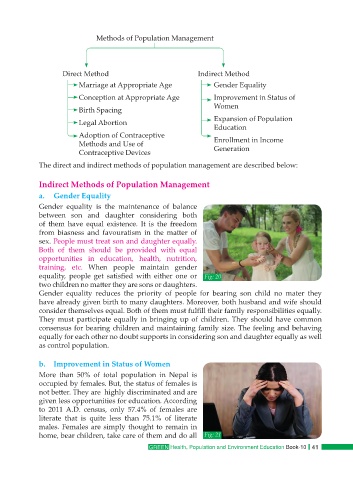
            equality,  people  get  satisfied  with  either  one  or  Fig: 20
            two children no matter they are sons or daughters.
            Gender  equality  reduces  the  priority  of  people  for  bearing  son  child  no  mater  they
            have already given birth to many daughters. Moreover, both husband and wife should
            consider themselves equal. Both of them must fulfill their family responsibilities equally.
            They must participate equally in bringing up of children. They should have common
            consensus for bearing children and maintaining family size. The feeling and behaving
            equally for each other no doubt supports in considering son and daughter equally as well
            as control population.

            b.  Improvement in Status of Women
            More than 50% of total population in Nepal is
            occupied by females. But, the status of females is
            not better. They are  highly discriminated and are
            given less opportunities for education. According
            to 2011  A.D. census,  only 57.4% of females are
            literate  that  is  quite  less  than  75.1%  of  literate
            males. Females are simply thought to remain in
            home, bear children, take care of them and do all  Fig: 21
                                            GREEN  Health, Population and Environment Education Book-10 41

