


Page 164 - leadership-experience-2008
P. 164
CikguOnline
         CikguOnline
               CHAPTER 5: LEADERSHIP MIND AND HEART                                                      145

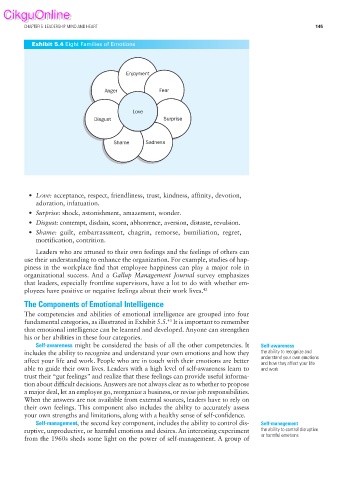
                  Exhibit 5.4 Eight Families of Emotions


                                               Enjoyment

                                        Anger            Fear


                                                 Love
                                     Disgust              Surprise


                                           Shame     Sadness


                •  Love: acceptance, respect, friendliness, trust, kindness, affinity, devotion,
                   adoration, infatuation.
                •  Surprise: shock, astonishment, amazement, wonder.
                •  Disgust: contempt, disdain, scorn, abhorrence, aversion, distaste, revulsion.
                •  Shame: guilt, embarrassment, chagrin, remorse, humiliation, regret,
                   mortification, contrition.
                   Leaders who are attuned to their own feelings and the feelings of others can
               use their understanding to enhance the organization. For example, studies of hap-
               piness in the workplace fi nd that employee happiness can play a major role in
                 organizational success. And a  Gallup Management Journal survey emphasizes
               that leaders, especially frontline supervisors, have a lot to do with whether em-
               ployees have positive or negative feelings about their work lives.
                                                                       42
               The Components of Emotional Intelligence
               The competencies and abilities of emotional intelligence are grouped into four
                                                            43
               fundamental categories, as illustrated in Exhibit 5.5.  It is important to remember
               that emotional intelligence can be learned and developed. Anyone can strengthen
               his or her abilities in these four categories.
                   Self-awareness might be considered the basis of all the other competencies. It   Self-awareness
                                                                                        Self-awareness
                                                                                        the ability to recognize and
                 includes the ability to recognize and understand your own emotions and how they   the ability to recognize and
                                                                                        understand your own emotions
                                                                                        understand your own emotions
               affect your life and work. People who are in touch with their emotions are better
                                                                                        and how they affect your life
                                                                                        and how they affect your life
               able to guide their own lives. Leaders with a high level of self-awareness learn to   and work
                                                                                        and work
               trust their “gut feelings” and realize that these feelings can provide useful informa-
               tion about difficult decisions. Answers are not always clear as to whether to propose

               a major deal, let an employee go, reorganize a business, or revise job responsibilities.
               When the answers are not available from external sources, leaders have to rely on
               their own feelings. This component also includes the ability to accurately assess
               your own strengths and limitations, along with a healthy sense of self-confi dence.
                   Self-management, the second key component, includes the ability to control dis-  Self-management
                                                                                        Self-management
                                                                                        the ability to control disruptive
               ruptive, unproductive, or harmful emotions and desires. An interesting  experiment   the ability to control disruptive
                                                                                        or harmful emotions
                                                                                        or harmful emotions
               from the 1960s sheds some light on the power of self-management. A group of

