


Page 168 - leadership-experience-2008
P. 168
CikguOnline
         CikguOnline
               Leader’s Self-Insight 5.2                                       Getty Images


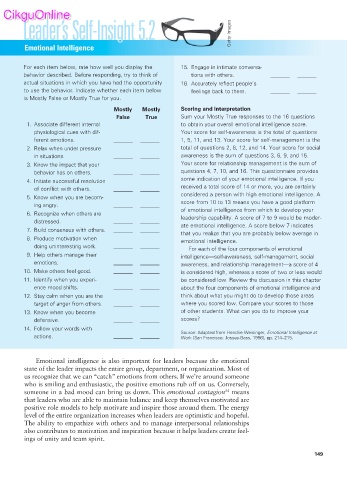
               For each item below, rate how well you display the   15. Engage in intimate conversa-
               behavior described. Before responding, try to think of   tions with others.  _______  _______
               actual situations in which you have had the opportunity   16. Accurately reflect people’s
               to use the behavior. Indicate whether each item below   feelings back to them.  _______  _______
               is Mostly False or Mostly True for you.

                                           Mostly   Mostly      Scoring and Interpretation
                                            False    True       Sum your Mostly True responses to the 16 questions
                1. Associate different internal                 to obtain your overall emotional intelligence score.
                  physiological cues with dif-                  Your score for self-awareness is the total of questions
                  ferent emotions.         _______   _______    1, 5, 11, and 13. Your score for self-management is the
                2. Relax when under pressure                    total of questions 2, 8, 12, and 14. Your score for social
                  in situations.           _______  _______     awareness is the sum of questions 3, 6, 9, and 15.
                3. Know the impact that your                    Your score for relationship management is the sum of
                  behavior has on others.  _______   _______    questions 4, 7, 10, and 16. This questionnaire provides
                                                                some indication of your emotional intelligence. If you
                4. Initiate successful resolution
                                                                received a total score of 14 or more, you are certainly
                  of conflict with others.  _______  _______
                                                                considered a person with high emotional intelligence. A
                5. Know when you are becom-
                                                                score from 10 to 13 means you have a good platform
                  ing angry.               _______   _______
                                                                of emotional intelligence from which to develop your
                6. Recognize when others are
                                                                leadership capability. A score of 7 to 9 would be moder-
                  distressed.              _______  _______
                                                                ate emotional intelligence. A score below 7 indicates
                7. Build consensus with others.  _______   _______
                                                                that you realize that you are probably below average in
                8. Produce motivation when                      emotional intelligence.
                  doing uninteresting work.  _______   _______
                                                                  For each of the four components of emotional
                9. Help others manage their                       intelligence—self- awareness, self-management, social
                  emotions.                _______  _______     awareness, and relationship management—a score of 4
               10. Make others feel good.  _______   _______    is considered high, whereas a score of two or less would
               11. Identify when you experi-                    be considered low. Review the discussion in this chapter
                  ence mood shifts.        _______  _______     about the four components of emotional intelligence and
               12. Stay calm when you are the                   think about what you might do to develop those areas
                  target of anger from others.  _______  _______  where you scored low. Compare your scores to those
               13. Know when you become                         of other students. What can you do to improve your
                  defensive.               _______  _______     scores?
               14. Follow your words with
                                                                Source: Adapted from Hendrie Weisinger, Emotional Intelligence at
                  actions.                 _______  _______     Work (San Francisco: Jossey-Bass, 1998), pp. 214–215.


                   Emotional intelligence is also important for leaders because the emotional
               state of the leader impacts the entire group, department, or organization. Most of
               us recognize that we can “catch” emotions from others. If we’re around someone
               who is smiling and enthusiastic, the positive emotions rub off on us. Conversely,
                                                                             54
               someone in a bad mood can bring us down. This emotional contagion  means
               that leaders who are able to maintain balance and keep themselves motivated are
               positive role models to help motivate and inspire those around them. The energy
               level of the entire organization increases when leaders are optimistic and hopeful.
               The ability to empathize with others and to manage interpersonal relationships
               also contributes to motivation and inspiration because it helps leaders create feel-
               ings of unity and team spirit.

                                                                                                         149

