


Page 249 - leadership-experience-2008
P. 249
CikguOnline
      CikguOnline
            230                                                               PART 4: THE LEADER AS A RELATIONSHIP BUILDER

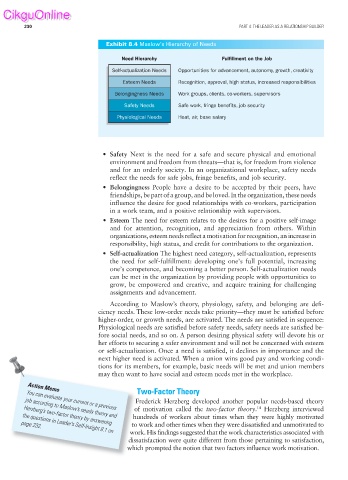
                                     Exhibit 8.4 Maslow’s Hierarchy of Needs

                                          Need Hierarchy                 Fulfillment on the Job
                                       Self-actualization Needs  Opportunities for advancement, autonomy, growth, creativity
                                           Esteem Needs     Recognition, approval, high status, increased responsibilities

                                        Belongingness Needs  Work groups, clients, co-workers, supervisors
                                           Safety Needs     Safe work, fringe benefits, job security
                                         Physiological Needs  Heat, air, base salary


                                    •  Safety Next is the need for a safe and secure physical and emotional
                                       environment and freedom from threats—that is, for freedom from violence
                                       and for an orderly society. In an organizational workplace, safety needs
                                       reflect the needs for safe jobs, fringe benefits, and job security.
                                    •  Belongingness People have a desire to be accepted by their peers, have
                                       friendships, be part of a group, and be loved. In the organization, these needs
                                       influence the desire for good relationships with co-workers, participation
                                       in a work team, and a positive relationship with supervisors.
                                    •  Esteem The need for esteem relates to the desires for a positive self-image
                                       and for attention, recognition, and appreciation from others. Within
                                       organizations, esteem needs reflect a motivation for recognition, an increase in
                                       responsibility, high status, and credit for contributions to the organization.
                                    •  Self-actualization The highest need category, self-actualization, represents
                                       the need for self-fulfillment: developing one’s full potential, increasing
                                       one’s competence, and becoming a better person. Self-actualization needs
                                       can be met in the organization by providing people with opportunities to
                                       grow, be empowered and creative, and acquire training for challenging
                                       assignments and advancement.
                                       According to Maslow’s theory, physiology, safety, and belonging are defi -
                                   ciency needs. These low-order needs take priority—they must be satisfi ed before

                                   higher-order, or growth needs, are activated. The needs are satisfied in sequence:

                                     Physiological needs are satisfied before safety needs, safety needs are satisfi ed be-
                                   fore social needs, and so on. A person desiring physical safety will devote his or
                                   her efforts to securing a safer environment and will not be concerned with esteem
                                   or self-actualization. Once a need is satisfied, it declines in importance and the

                                   next higher need is activated. When a union wins good pay and working condi-
                                   tions for its members, for example, basic needs will be met and union members
                                   may then want to have social and esteem needs met in the workplace.


             Action Memo
                                               Two-Factor Theory
                                              Frederick Herzberg developed another popular needs-based theory
                                              of motivation called the  two-factor theory.  Herzberg interviewed
             You can evaluate your current or a previous
                                                                                    14
            job according to Maslow’s needs theory and
                                              hundreds of workers about times when they were highly motivated
            Herzberg’s two-factor theory by answering

           page 232.                         to work and other times when they were dissatisfied and unmotivated to
            the questions in Leader’s Self-Insight 8.1 on

                                             work. His findings suggested that the work characteristics associated with
                                            dissatisfaction were quite different from those pertaining to satisfaction,

                                            which prompted the notion that two factors influence work motivation.

