


Page 245 - leadership-experience-2008
P. 245
CikguOnline
      CikguOnline
            226                                                               PART 4: THE LEADER AS A RELATIONSHIP BUILDER
                                   Leadership and Motivation

                                   Most of us get up in the morning, go to school or work, and behave in ways that
                                   are predictably our own. We usually respond to our environment and the people
                                   in it with little thought as to why we work hard, enjoy certain classes, or fi nd
                                   some recreational activities so much fun. Yet all these behaviors are motivated
            Motivation             by something. Motivation refers to the forces either internal or external to a person
            Motivation
            the forces either internal or   that arouse enthusiasm and persistence to pursue a certain course of action. Em-
            the forces either internal or
            external to a person that arouse
            external to a person that arouse
            enthusiasm and persistence to
            enthusiasm and persistence to   ployee motivation affects productivity, and so part of a leader’s job is to channel
            pursue a certain course of action
            pursue a certain course of action  followers’ motivation toward the accomplishment of the organization’s vision
                                            2
                                   and goals.  The study of motivation helps leaders understand what prompts peo-
                                   ple to initiate action, what influences their choice of action, and why they persist

                                   in that action over time.
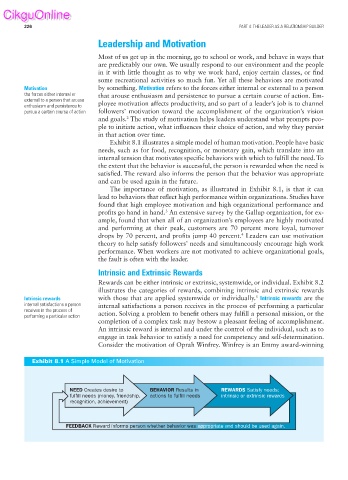
                                       Exhibit 8.1 illustrates a simple model of human motivation. People have basic
                                   needs, such as for food, recognition, or monetary gain, which translate into an
                                   internal tension that motivates specific behaviors with which to fulfi ll the need. To

                                   the extent that the behavior is successful, the person is rewarded when the need is

                                   satisfied. The reward also informs the person that the behavior was appropriate
                                   and can be used again in the future.
                                       The importance of motivation, as illustrated in Exhibit 8.1, is that it can

                                   lead to behaviors that reflect high performance within organizations. Studies have
                                   found that high employee motivation and high organizational performance and
                                                        3
                                   profi ts go hand in hand.  An extensive survey by the Gallup organization, for ex-
                                   ample, found that when all of an organization’s employees are highly motivated
                                   and performing at their peak, customers are 70 percent more loyal, turnover
                                                                               4

                                   drops by 70 percent, and profits jump 40 percent.  Leaders can use motivation
                                   theory to help satisfy followers’ needs and simultaneously encourage high work
                                   performance. When workers are not motivated to achieve organizational goals,
                                   the fault is often with the leader.
                                   Intrinsic and Extrinsic Rewards
                                   Rewards can be either intrinsic or extrinsic, systemwide, or individual. Exhibit 8.2
                                   illustrates the categories of rewards, combining intrinsic and extrinsic rewards
                                                                                    5
            Intrinsic rewards      with those that are applied systemwide or individually.  Intrinsic rewards are the
            Intrinsic rewards
            internal satisfactions a person   internal satisfactions a person receives in the process of performing a particular
            internal satisfactions a person
            receives in the process of
            receives in the process of

            performing a particular action
            performing a particular action  action. Solving a problem to benefit others may fulfi ll a personal mission, or the
                                   completion of a complex task may bestow a pleasant feeling of accomplishment.
                                   An intrinsic reward is internal and under the control of the individual, such as to
                                   engage in task behavior to satisfy a need for competency and self-determination.
                                   Consider the motivation of Oprah Winfrey. Winfrey is an Emmy award-winning
               Exhibit 8.1 A Simple Model of Motivation


                          NEED Creates desire to   BEHAVIOR Results in   REWARDS Satisfy needs;
                          fulfill needs (money, friendship,  actions to fulfill needs  intrinsic or extrinsic rewards
                          recognition, achievement)


                         FEEDBACK Reward informs person whether behavior was appropriate and should be used again.

