


Page 247 - leadership-experience-2008
P. 247
CikguOnline
      CikguOnline
            228                                                               PART 4: THE LEADER AS A RELATIONSHIP BUILDER
                                       On the job, people may always have to perform some activities they don’t
                                   particularly like, but leaders try to match followers with jobs and tasks that
                                   provide individual intrinsic rewards.  They also strive to create an environ-
                                   ment where people feel valued and feel that they are contributing to something
                                   worthwhile, helping followers achieve systemwide intrinsic rewards. In Fortune
                                   magazine’s annual list of “100 Best Companies to Work For,” one of the primary
                                    characteristics shared by best companies is that they are purpose-driven; that
                                               is, people have a sense that what they do matters and makes a
             Action Memo
                                                                           9
                                               positive difference in the world.  One example is Les Schwab Tire
                                              Centers, where employees feel like partners united toward a goal
             As a leader, you can provide extrinsic
                                              of making people’s lives easier. Stores fi x fl ats for free, and some
            rewards, such as promotions, pay raises,
                                             have been known to install tires hours before opening time for an
            and praise, but also help followers achieve
                                             emergency trip. Employees frequently stop to help stranded motor-
            intrinsic rewards and meet their higher-
                                             ists. Schwab rewards people with a generous profi t-sharing plan for
           and fulfi  llment.
           level needs for accomplishment, growth,
                                            everyone and promotes store managers solely from within. These ex-
                                            ternal rewards supplement the intrinsic rewards people get from their
                                           work, leading to extremely high motivation. 10
                                   Higher Versus Lower Needs
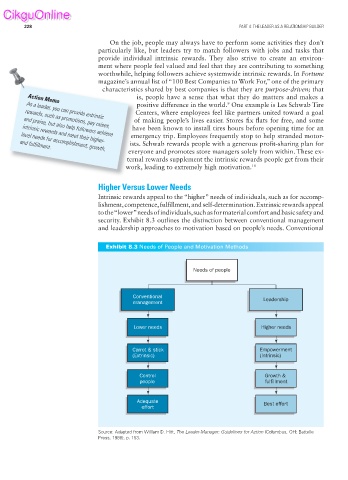
                                   Intrinsic rewards appeal to the “higher” needs of individuals, such as for accomp-

                                   lishment, competence, fulfillment, and self-determination. Extrinsic rewards appeal
                                   to the “lower” needs of individuals, such as for material comfort and basic safety and
                                   security. Exhibit 8.3 outlines the distinction between conventional management
                                   and leadership approaches to motivation based on people’s needs. Conventional


                                     Exhibit 8.3 Needs of People and Motivation Methods


                                                                Needs of people


                                              Conventional                            Leadership
                                              management


                                              Lower needs                            Higher needs


                                              Carrot & stick                         Empowerment
                                              (Extrinsic)                            (Intrinsic)


                                                Control                               Growth &
                                                people                                fulfillment


                                               Adequate                               Best effort
                                                effort


                                   Source: Adapted from William D. Hitt, The Leader-Manager: Guidelines for Action (Columbus, OH: Battelle
                                   Press, 1988), p. 153.

