


Page 363 - leadership-experience-2008
P. 363
CikguOnline
      CikguOnline
            344                                                               PART 4: THE LEADER AS A RELATIONSHIP BUILDER
                                   aware of the impact that culture may have and consider cultural values in their
                                   dealings with employees.


                                   Stages of Personal Diversity Awareness

                                   One goal for today’s global organizations is to ensure that  all employees and
                                   customers—women, ethnic and racial minorities, gay people, the disabled, the el-
                                   derly, as well as white males—are given equal opportunities and treated with fair-
                                   ness and respect.  Strong, culturally sensitive leadership can move organizations
                                                 72
                                   toward diversity, where all individuals are valued and respected for the unique
                                   abilities they can bring to the workplace.
                                       Leaders vary in their sensitivity and openness to other cultures, attitudes,
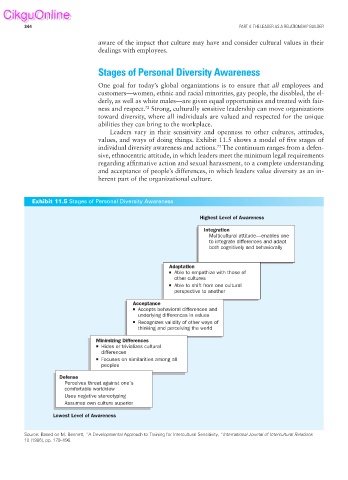
                                   values, and ways of doing things. Exhibit 11.5 shows a model of fi ve stages of
                                                                        73
                                   individual diversity awareness and actions.  The continuum ranges from a defen-
                                   sive, ethnocentric attitude, in which leaders meet the minimum legal requirements
                                   regarding affi rmative action and sexual harassment, to a complete understanding
                                   and acceptance of people’s differences, in which leaders value diversity as an in-
                                   herent part of the organizational culture.


               Exhibit 11.5 Stages of Personal Diversity Awareness

                                                                  Highest Level of Awareness

                                                                    Integration
                                                                     Multicultural attitude—enables one
                                                                     to integrate differences and adapt
                                                                     both cognitively and behaviorally


                                                         Adaptation
                                                          Able to empathize with those of
                                                          other cultures
                                                          Able to shift from one cultural
                                                          perspective to another
                                              Acceptance
                                               Accepts behavioral differences and
                                               underlying differences in values
                                               Recognizes validity of other ways of
                                               thinking and perceiving the world
                                  Minimizing Differences
                                    Hides or trivializes cultural
                                    differences
                                    Focuses on similarities among all
                                    peoples
                       Defense
                         Perceives threat against one’s
                         comfortable worldview
                         Uses negative stereotyping
                         Assumes own culture superior

                     Lowest Level of Awareness

            Source: Based on M. Bennett, “A Developmental Approach to Training for Intercultural Sensitivity, “International Journal of Intercultural Relations
            10 (1986), pp. 179–196.

